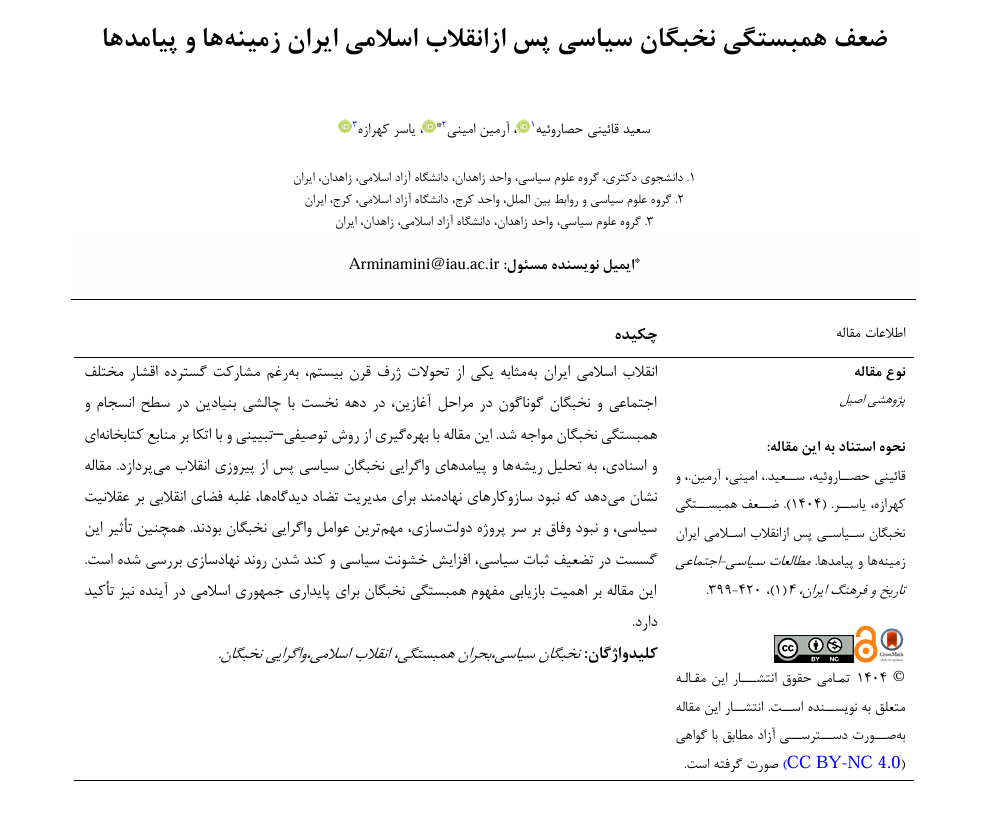
Weak Cohesion among Political Elites after the Islamic Revolution of Iran: Contexts and Consequences
Keywords:
Political elites, solidarity crisis, Islamic revolution, elite divergenceAbstract
The Islamic Revolution of Iran, as one of the profound transformations of the twentieth century, was initially characterized by the broad participation of various social groups and diverse elites. Nevertheless, during its first decade, it encountered a fundamental challenge concerning the cohesion and solidarity of political elites. Using a descriptive–explanatory method and drawing on library and documentary sources, this article analyzes the roots and consequences of divergence among political elites following the victory of the Revolution. The findings demonstrate that the absence of institutionalized mechanisms for managing conflicting viewpoints, the predominance of revolutionary fervor over political rationality, and the lack of consensus regarding the state-building project were the principal factors contributing to elite divergence. The article also examines the effects of this fragmentation on the weakening of political stability, the escalation of political violence, and the deceleration of the institution-building process. Finally, it emphasizes the importance of revitalizing the concept of elite cohesion to ensure the future sustainability of the Islamic Republic.
Downloads
References
Abdi, A. (2004). An Examination of the Causes of Elite Cleavages in the Power Structure of the Islamic Republic of Iran. Institute for Development Studies.
Abedi, M. (2016). Political Cleavages and Their Consequences in Iran's Power Structure. Policy Research Quarterly.
Alavitabar, S. (2015). The Sociology of Power Cleavages in Post-Revolutionary Iran. Tarh-e No Publishing.
Alavitabar, S. (2019). An Analysis of Elite Cleavages During Rouhani's Second Administration. Siasatnameh Quarterly, 4(2).
Bashiriyeh, H. (1998). Sociology of Political Elites. Negah-e Moaser Publications.
Bashiriyeh, H. (2001). The Transformation of Political Thought in Iran. Ney Publishing.
Bashiriyeh, H. (2018). The Decline of Elites and the Turn of Discourses in the Islamic Republic. Ney Publishing.
Beetham, D. (1991). The Legitimation of Power. Palgrave Macmillan.
Burton, M., & Higley, J. (1987). Elite Settlements and the Stability of Democracies. American Sociological Review, 52(2), 295-307.
Fakouhi, N. (2011). Political Anthropology. Ney Publishing.
Fazeli, N. (2011). Generational and Elite Cleavages in Contemporary Iran. Iranian Cultural Research Quarterly, 4(2).
Fazeli, N. (2017). Culture and Politics in Iran. Tisa Publishing.
Ghaderi, M. (2004). Elites and Politics in Iran After the Revolution. Institute for Cultural Studies and Research.
Hashemi, F. (2019). Functional Legitimacy of Government and Governance Challenges. Rahbord Quarterly.
Hateminejad, S. H. (2010). A Sociological Analysis of the Process of Elite Cohesion and Divergence in the Islamic Republic of Iran. Strategic Studies of public policy, 1(1).
Kadivar, M. (2011). Revisiting Fundamental Cleavages in the Power Structure. Cheshmandaz-e Iran(69).
Kamali, H. (2017). State, Society, and Development in Iran. Institute for Strategic Studies.
Katouzian, M. A. (2013). The Political and Social Structure of Contemporary Iran. Elm Publishing Center.
Kazemi, H. (2017). A Comparative Analysis of Political Elites in Post-Revolutionary Iran. Political Science Research Journal.
Kazemi, R. (2018). A Genealogy of Power Dualities in the Islamic Republic. Iran Today Quarterly(42).
Khezri, H. (2012). Politics and Elites in the Islamic Republic of Iran. Research Institute for Islamic Culture and Thought.
Linz, J. J., & Stepan, A. (1996). Problems of Democratic Transition and Consolidation: Southern Europe, South America, and Post-Communist Europe. Johns Hopkins University Press.
Montazeri, M. (2021). Developments in the Rouhani Administration and the Paradoxes of Elite Cleavages. Strategic Policy Studies(61).
Nasri, N. (2012). Ahmadinejad's Justice-Oriented Discourse and Its Conflict with Traditional Elites. Political Science Research Journal(52).
Pareto, V. (1968). The Rise and Fall of Elites. Transaction Publishers.
Putnam, R. D. (1993). Making Democracy Work: Civic Traditions in Modern Italy. Princeton University Press.
Sadeghi, M. (2019). Legitimacy Crisis and Elite Cleavages in the Moderation Government. Iranian Policy Research Quarterly, 5(1).
Saei, A. (2008). Obstacles to Political Cohesion in the Post-Revolutionary Power Structure. Islamic Revolution Studies, 5(18).
Saei, A. (2014). Discourse Analysis of Elite Cleavages in the Ninth and Tenth Administrations. Strategic Studies of public policy, 2(4).
Tajik, M. R. (2002). Political Elites and Social Cleavages. Political Science Quarterly(16).
Tajik, M. R. (2008). The Discourse of Political Elites After the Islamic Revolution of Iran. Ney Publishing.
Tajik, M. R. (2019). Transformation of Dominant Discourses and Its Consequences for Elite Cohesion. Quarterly Journal of Political and Social Studies of Contemporary Iran(3).
Zarifian, G. (2021). Politics and Society in the Islamic Republic of Iran. Morvarid Publishing.
Zibakalam, S. (2013). Iranian Politics: From Khatami to Ahmadinejad. Rozaneh Publications.
Downloads
Publication Timeline
- Submitted
- Revised
- Accepted
Issue
Section
License
Copyright (c) 2025 Saeed Qaeini Hesaroyieh (Author); Armin Amini; Yaser Kahrazeh (Author)

This work is licensed under a Creative Commons Attribution-NonCommercial 4.0 International License.