Qualitative Documentary Analysis of the Consequences of New Media and Cognitive Warfare for the Political Behavior of the Younger Generation
Keywords:
New media, cognitive warfare, political behavior, younger generation, qualitative document analysis, media literacyAbstract
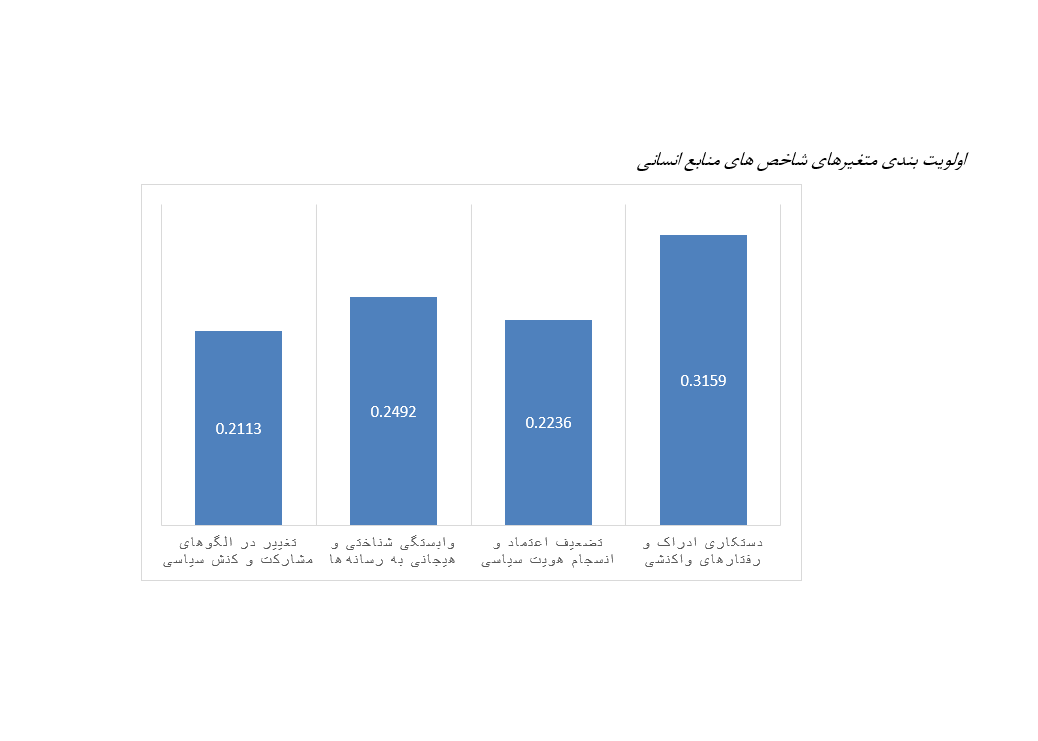
This study aimed to analyze and prioritize the consequences of new media and cognitive warfare for the political behavior of the younger generation and to explain the cognitive, emotional, and political mechanisms resulting from the interaction between these two factors. This applied study employed a qualitative documentary approach based on content analysis. Data were collected through the examination of relevant domestic and international scientific sources, articles, reports, and previous studies. The retrieved evidence was analyzed through open coding, categorization, and axial coding, while MAXQDA was used to organize and analyze the qualitative data and extract the final codes and themes. The trustworthiness of the findings was evaluated according to Lincoln and Guba’s criteria of transferability, credibility, confirmability, and dependability, and coding reliability was assessed through inter-rater agreement. In the final stage, the fuzzy analytic hierarchy process was employed to determine the relative importance and priority of the main identified consequences. The analytical findings revealed four overarching consequences: manipulation of political perception and reactive behaviors, cognitive and emotional dependence on media, weakening of political trust and identity cohesion, and changes in patterns of political participation and action. Fuzzy prioritization showed that manipulation of perception and reactive behaviors had the greatest relative importance (weight = 0.3159), followed by cognitive and emotional dependence on media (0.2492), weakening of political trust and identity cohesion (0.2236), and changes in political participation and action patterns (0.2113). The resulting hierarchy indicates that the cognitive and emotional mechanisms associated with new media and cognitive warfare exert a more substantial influence on young people’s political behavior than changes in the form of political participation alone. The interaction of new media and cognitive warfare may orient the political behavior of the younger generation toward cognitive dependence, emotionalized political responses, declining political trust, and reactive forms of political action. Accordingly, strengthening media literacy, critical thinking skills, and cognitive resilience should constitute central components of educational, media, and policymaking interventions targeting younger populations.
Downloads
References
Abou Karam, S. (2023). Social media and the youth activism: The case of Generation Z in Iran. Rasānah / Journal for Iranian Studies.
Abouli, A., Haghighi, A. M., & Zarei, G. (2022). The effect of virtual social networks on the political behavior of Iranian citizens (2008–2018). Geography (Regional Planning), 12(46), 713-732. https://doi.org/10.22034/jgeoq.2022.318871.3462
Adams, Z., & Adams, Z. (2023). (Why) Is misinformation a problem? International Journal of Communication and Information Studies.
Adeeb, R. A., & Mirhoseini, M. (2023). The impact of affect on the perception of fake news on social media: A systematic review. Social Sciences, 12(12), 674.
Ahmadpour Torkmani, B., AzKia, M., & Sarokhani, B. (2020). The role of virtual social networks in the political socialization of youth: Emphasis on media access and active users. Media Studies, 13(41), 21-39.
Alodat, A. M. (2023). Social media platforms and political participation: A study of Jordanian youth. Social Sciences, 12(7), 402.
Arayankalam, J. (2021). Relating foreign disinformation through social media to offline violence. Technological Forecasting and Social Change.
Arrazak, M., & Adnan, M. (2025). The influence of social media usage and political trust on young voters political participation in Padang City. Jurnal ISO: Jurnal Ilmu Sosial, Politik Dan Humaniora, 5(1), 11. https://doi.org/10.53697/iso.v5i1.2160
Asghar, N., Cheema, A. T., & Muzaffar, M. (2025). The impact of media coverage on political behavior among Pakistani students: A case study of GC Women University Sialkot. Journal of Development and Social Sciences, 6(2), 266-279. https://doi.org/10.47205/jdss.2025(6-II)23
Barati, M. (2023). Casual social media use among the youth: Effects on political participation. JeDEM — Journal of e-Democracy and Open Government.
Behrouzi, E. (2025). The impact of social media on political behavior and civic participation in contemporary societies. Seventh International and Eighth National Conference on Law and Political Science,
Bohn, R. (2024). Impact and effects of informational social media use on political expression
Conde, J. (2025). The emergence of cognitive intelligence (COGINT) as a framework for modern information operations. Journal of Information Warfare.
Deppe, C., & Schaal, G. S. (2024). Cognitive warfare: A conceptual analysis of the NATO ACT cognitive warfare exploratory concept. Frontiers in Big Data, 7, 1452129. https://doi.org/10.3389/fdata.2024.1452129
Eraqi, A., Bidgoli, M., & Rajabi Deh Borzoui, A. (2022). Examining the objectives of enemy cognitive warfare and resilience strategies for countering it with emphasis on Quranic teachings. Sacred Defense Studies, 8(4), 143-162.
Fakouri Rava, H., Ghasemi, H., Aghayan, J., & Ghorbanzadeh Savar, G. (2024). Countering cognitive warfare in Islamic governance: The strategic role of explanatory jihad in the thought of the Supreme Leader. Governance Principles, 2(4), e726722. https://doi.org/10.22034/ah.2025.2062780.1051
Ghorbani, A. (2025). Social capital created for Iran during the twelve-day war with the Zionist regime.
Golafshannia, S., Khosravi, M., Mortazavian, S. A., & Bakhshayesh Ardestani, A. (2025). The role of cyberspace in political activism and electoral participation among young people born in the 1990s: An analysis of changing patterns of political and social participation. Political-Social Studies of Iranian History and Culture, 4(3), 1-13. https://journalspsich.com/index.php/journalspsich/article/view/394
Hansen, T., Taylor, C. K., & Knowles, R. T. (2025). Digital media and political engagement: Shaping youth environmental attitudes and behaviors in four European societies. Societies, 15(11), 300. https://doi.org/10.3390/soc15110300
Iqbal, A., Hassan, S., & Mayo, A. M. (2024). Impact of social media use on voting behavior of youth during general elections-2013. Journal of Social Signs Review, 2(4), 569-593. https://socialsignsreivew.com/index.php/12/article/view/63
Jangizehi, S., Jangidad, N., & Jangizehi, P. (2024). Analysis of the impact of popular culture on political behavior: A study of the younger generation. Second International Conference on New Research in Education,
Jia, N., & Lee, Y. F. (2025). The influence of social media content on political identity with corruption perception as a moderator. Frontiers in Political Science, 7. https://doi.org/10.3389/fpos.2025.1659804
Kanaaninassab, S., Motaghi, E., Roshanayi, A., Shekarbeigi, A., & Mirzaei, K. (2020). A sociological study of the effect of lifestyle on students’ political participation: The case of Razi University students in Kermanshah.
Khan, M. Q., & Fatima, B. (2025). Exploring digital democracy in Pakistan: The impacts of social media on political participation among university students.
Kops, M. (2025). Young people and false information: A scoping review of research on youth responses to misinformation. Journal of Communication Research.
Marjanović, A., & Smiljanic, D. (2025). Cognitive warfare - the human mind as the new battlefield.
Matthes, J. (2022). Social media and the political engagement of young adults: Theoretical perspectives and empirical findings. Online Media & Government Communication.
Mohammadi Fateh, A., Arvand, H., & Jokar, A. (2024). A reflection on the theoretical foundations of cognitive warfare based on metasynthesis. Strategic Management Perspective, 2(4), 71-118.
Mousavi, S. M. (2025). Foundations and strategies for countering cognitive warfare in Islamic governance.
Mueller, J. C. (2025). Youth politics and cognitive mapping in the United States: From #OKBoomer to #BlackLivesMatter and #CeasefireNow. Peace Review, 37(1), 217-234. https://doi.org/10.1080/10402659.2025.2456169
Nguyen, T. T., Nguyen, D. C., Nguyen, H. T., Do, H. T., Ngo, T., Pham, A. B. G., Tran, T. Q., Hoang, L. P., Dang, H., Boyer, L., Fond, G., Auquier, P., & Zhang, M. W. B. (2025). Exposure to fake news on social media, coping mechanisms, and mental health impact among Vietnamese adolescents and young adults. Scientific reports, 15, 35117.
Nyianle, J. B. M. (2025). Social media and political participation among youth in African democracies. Journal of African Social Development.
Osmani, B. (2025). Psychological impact of political populism in internet media: A study of perceptions among youth in North Macedonia. https://ssrn.com/abstract=5287929
Paziuk, A., Lande, D., Shnurko-Tabakova, E., & Kingston, P. (2025). Decoding manipulative narratives in cognitive warfare: a case study of the Russia-Ukraine conflict. Frontiers in Artificial Intelligence, 8, 1566022. https://doi.org/10.3389/frai.2025.1566022
Political Information Literacy Working, G. (2023). Conceptualizing political information literacy among young people. Journal of Information, Communication & Society.
Qosja, I. (2022). The impact of social media on youth political behavior. Polis, 21, 14-22. https://doi.org/10.58944/njtx1623
Qosja, I. (2023). The impact of social media on youth political behavior. UET Political Science Journal.
Rezaei, D., & Ebrahimi, H. (2024). Identifying factors, challenges, and strategies for countering cognitive warfare with a focus on Generation Z in Iran. Air Defense Management, 3(2), 27-42.
Sabzevari, A. H., Dastmard, S. R., Shokouhi, A. R., Heydarizadeh, Y., Naghdi, M. H., & Khosravi, M. R. (2025). Analysis of the role of media and social networks in hybrid warfare.
Santos, M., Naranjo-Zolotov, M., Nguyen Long, L. A., Acedo, A., Ashofteh, A., & Aparício, M. (2025). Beyond social norms: Exploring the drivers of youth’s political participation via social media. Emerging Science Journal, 9(2), 588-602. https://doi.org/10.28991/ESJ-2025-09-02-05
Sardarnia, K., Aminizadeh, S., & Hasanvand, M. (2019). The effect of new media on students’ political participation through social variables: The case of Shiraz University students. Applied Sociology, 30(2), 85-100. https://doi.org/10.22108/jas.2018.109527.1307
Solihat, M. (2024). Gen Z communication and political participation in digital environments. International Conference on Social Science,
Tavassoli Tabaei Zavareh, S. A. (2023). Explaining the components of cognitive warfare in Ayatollah Khamenei’s political thought. Journal of Social and Political Cognitive Studies, 1(1), 24-41.
Vasist, P. N. (2023). The polarizing impact of political disinformation and hate: A cross-country investigation. Humanities and Social Sciences Communications.
Venus, A., Intyaswati, D., Ayuningtyas, F., & Lestari, P. (2025). Political participation in the digital age: Impact of influencers and advertising on Generation Z. Cogent Arts & Humanities, 12(1). https://doi.org/10.1080/23311983.2025.2520063
Wan Husin, W. N., & Zainurin, S. (2025). The role of social media in influencing youth political behavior: A systematic literature review. Pakistan Journal of Life and Social Sciences, 22. https://doi.org/10.57239/PJLSS-2024-22.2.001763
Downloads
Publication Timeline
- Submitted
- Revised
- Accepted
Issue
Section
License
Copyright (c) 2026 Mohammad Raja Parniyan (Author); Ghaffar Zarei (Corresponding Author); Amin Ravanbod (Author)

This work is licensed under a Creative Commons Attribution-NonCommercial 4.0 International License.