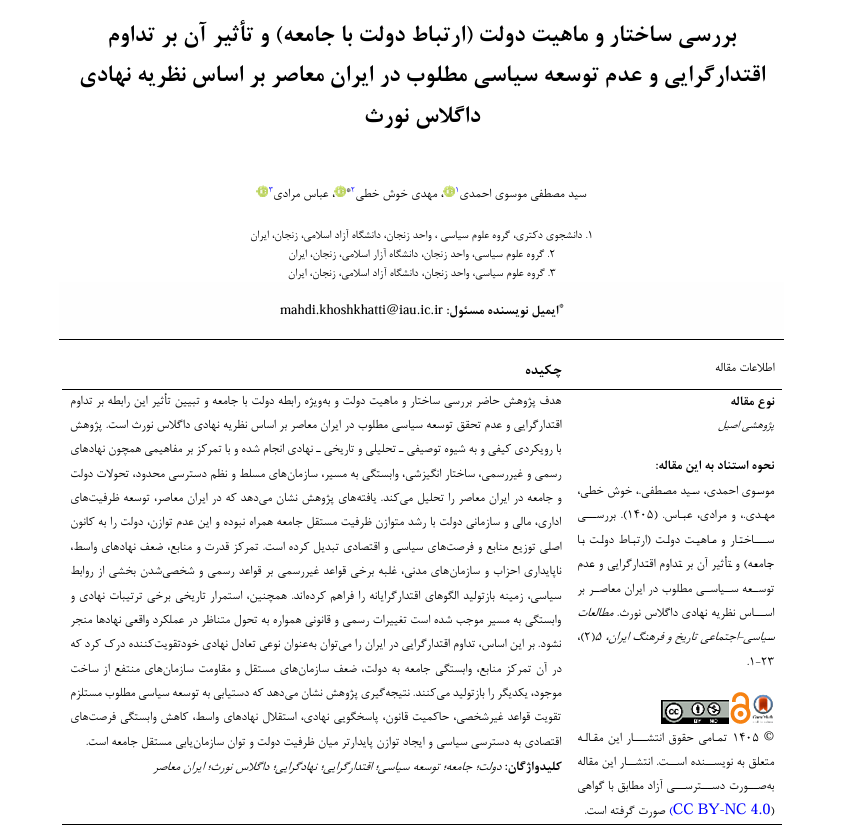
بررسی ساختار و ماهیت دولت (ارتباط دولت با جامعه) و تأثیر آن بر تداوم اقتدارگرایی و عدم توسعه سیاسی مطلوب در ایران معاصر بر اساس نظریه نهادی داگلاس نورث
کلمات کلیدی:
دولت, جامعه, نهادیگرایی, داگلاس نورث, اقتدارگرایی, توسعه سیاسیچکیده
هدف پژوهش حاضر بررسی ساختار و ماهیت دولت و بهویژه رابطه دولت با جامعه و تبیین تأثیر این رابطه بر تداوم اقتدارگرایی و عدم تحقق توسعه سیاسی مطلوب در ایران معاصر بر اساس نظریه نهادی داگلاس نورث است. پژوهش با رویکردی کیفی و به شیوه توصیفی ـ تحلیلی و تاریخی ـ نهادی انجام شده و با تمرکز بر مفاهیمی همچون نهادهای رسمی و غیررسمی، ساختار انگیزشی، وابستگی به مسیر، سازمانهای مسلط و نظم دسترسی محدود، تحولات دولت و جامعه در ایران معاصر را تحلیل میکند. یافتههای پژوهش نشان میدهد که در ایران معاصر، توسعه ظرفیتهای اداری، مالی و سازمانی دولت با رشد متوازن ظرفیت مستقل جامعه همراه نبوده و این عدم توازن، دولت را به کانون اصلی توزیع منابع و فرصتهای سیاسی و اقتصادی تبدیل کرده است. تمرکز قدرت و منابع، ضعف نهادهای واسط، ناپایداری احزاب و سازمانهای مدنی، غلبه برخی قواعد غیررسمی بر قواعد رسمی و شخصیشدن بخشی از روابط سیاسی، زمینه بازتولید الگوهای اقتدارگرایانه را فراهم کردهاند. همچنین، استمرار تاریخی برخی ترتیبات نهادی و وابستگی به مسیر موجب شده است تغییرات رسمی و قانونی همواره به تحول متناظر در عملکرد واقعی نهادها منجر نشود. بر این اساس، تداوم اقتدارگرایی در ایران را میتوان بهعنوان نوعی تعادل نهادی خودتقویتکننده درک کرد که در آن تمرکز منابع، وابستگی جامعه به دولت، ضعف سازمانهای مستقل و مقاومت سازمانهای منتفع از ساخت موجود، یکدیگر را بازتولید میکنند. نتیجهگیری پژوهش نشان میدهد که دستیابی به توسعه سیاسی مطلوب مستلزم تقویت قواعد غیرشخصی، حاکمیت قانون، پاسخگویی نهادی، استقلال نهادهای واسط، کاهش وابستگی فرصتهای اقتصادی به دسترسی سیاسی و ایجاد توازن پایدارتر میان ظرفیت دولت و توان سازمانیابی مستقل جامعه است.
دانلودها
مراجع
Acemoglu, D., & Robinson, J. A. (2012). Why Nations Fail: The Origins of Power, Prosperity and Poverty. Crown Business.
Aligica, P. D., & Boettke, P. J. (2009). Challenging Institutional Analysis and Development: The Bloomington School. Routledge.
Bardhan, P. (2005). Scarcity, Conflicts, and Cooperation: Essays in the Political and Institutional Economics of Development. MIT Press.
Bashiriyeh, H. (2002). Transformation of the State and Revolution in Iran. Ney Publishing.
Bashiriyeh, H. (2014). Obstacles to Political Development in Iran. Gam-e Now.
Coppedge, M., Gerring, J., Lindberg, S. I., Skaaning, S. E., Teorell, J., Altman, D., & Wilson, S. (2021). V-Dem Dataset v11.1.
Danesh, A. (2019). Institutional Analysis of Political Development in Iran Based on Douglass North's Perspective. Politics Quarterly, 48(2), 145-172.
Dowlatabadi, M. (2020). Interaction of Formal and Informal Institutions in the Public Policy-Making Process. Public Policy Quarterly, 5(3), 23-48.
Fazeli, Y. (2015). Institutional Analysis of the Structure of Power in Iran. Political Thought in Islam, 1(2), 23-47.
Fukuyama, F. (2014). Political Order and Political Decay: From the Industrial Revolution to the Globalization of Democracy. Farrar, Straus and Giroux.
Hajarian, S. (2008). From Sacred Witness to Modern Citizen. Ney Publishing.
Hall, P. A., & Taylor, R. C. R. (1996). Political science and the three new institutionalisms. Political Studies, 44(5), 936-957.
Jahangiri, R. (2021). The Impact of Formal and Informal Institutions on the Democratization Process in Iran. Journal of Political Developments in the Islamic World, 9(3), 79-103.
Khezri, M. J. (2017). The Role of Political Structure in the Reproduction of Authoritarianism in Iran. Strategic Studies of public policy, 8(1), 117-136.
Maleki, A. (2016). Analysis of State-Constraining Institutions in Post-Revolutionary Iran. Rahbord Quarterly, 24(1), 99-124.
March, J. G., & Olsen, J. P. (1989). Rediscovering Institutions: The Organizational Basis of Politics. Free Press.
Mosallanejad, A. (2013). Policy-Making and the Structure of Power in Iran. University of Tehran Press.
North, D. C. (1990). Institutions, Institutional Change and Economic Performance. Cambridge University Press.
North, D. C., Wallis, J. J., & Weingast, B. R. (2009). Violence and Social Orders: A Conceptual Framework for Interpreting Recorded Human History. Cambridge University Press.
Rothstein, B. (2011). The Quality of Government: Corruption, Social Trust, and Inequality in International Perspective. University of Chicago Press.
Saeidi, M. (2014). The Role of Political Culture in the Consolidation of Authoritarianism. Iranian Political Sociology Research Journal, 4(1), 91-113.
Safari, N. (2021). Institutional Obstacles to Political Development in the Islamic Republic of Iran. Comparative Politics Quarterly, 9(4), 65-90.
Sanaei, B. (2016). The Relationship between the Institutional Structure of the State and Political Development in Iran. Political Science Research Journal, 11(4), 33-57.
Sariolghalam, M. (2024). Political Culture of Iran. Farzan Rooz Publishing Institute.
Tajik, M. (2003). Soft Authoritarianism in Contemporary Iran. Quarterly Journal of Political Science, 6(1), 59-82.
Yousefi, R. (2019). The Relationship between Political Centralization and Underdevelopment in Iran. Political Science Research, 14(3), 201-224.
Zeinoddini, S. (2018). State Structure and the Reproduction of Authority in Iran: An Institutional Analysis. Political Studies Quarterly, 13(1), 71-99.
دانلودها
گاهشمار انتشار
- ارسال
- بازنگری
- پذیرش
شماره
نوع مقاله
مجوز
حق نشر 2026 Seyyed Mostafa Mousavi Ahmadi (Author); Mahdi Khoshkhatti (Corresponding Author); Abbas Moradi (Author)

این پروژه تحت مجوز بین المللی Creative Commons Attribution-NonCommercial 4.0 می باشد.