Analysis of motifs on tombstones in “Gharibeh” cemetery in Sir Firoozabad area of Kermanshah
Keywords:
Kermanshah, Sarfiroozabad, Kaleh Job, Gharibeh Cemetery, tombstone designsAbstract
Sir Firoozabad region is located in the east and southeast of Mahidasht and also in the south of Kermanshah. Archaeologically and historically, it is one of the most pristine and unknown parts of Kermanshah province.This area has been less studied by researchers for various reasons, including being marginal, impassable roads and having a mobile nomadic community.
the landmarks of Sarfiroozabad region is the number of cemeteries which, 36 of them can be seen. The history of these works dates back to different historical periods in the Islamic period and apparently most of them belong to the contemporary period. Gharibeh Cemetery or "Khoriveh" is one of these works, which according to local reports, as well as the existence and observation of a tomb belonging to a person named Salar Khan in 1107 AH. That is, it is related to the end of the Safavid dynasty and is still used today.
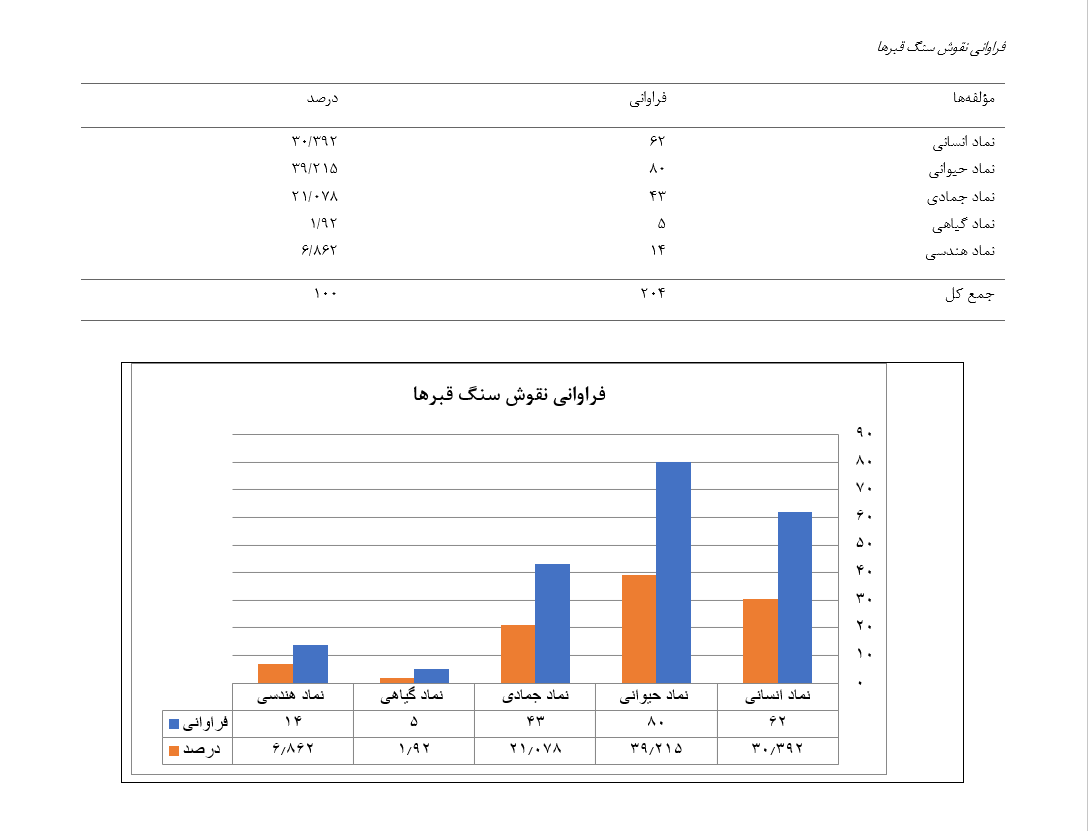
The present article intends to analyze the images engraved on the graves of "Gharibeh" or "Khriveh" cemetery as a research community And decipher the meanings of these engraved images, Therefore, data were collected from a set of 204 samples based on purposive sampling. Content analysis method was used to examine the data . And by classifying the types of motifs in the form of human, animal, plant, solid, geometric symbols, the results obtained show that the images of tombstones were not only aesthetic and decorative aspects , but also as a valid and first-hand document that shows the religious, cultural and social characteristics of the area. By analyzing these images, one can achieve the social and religious context of the inhabitants and the type and manner of their livelihood, and even their interests and hobbies.
Downloads
References
Armed Forces Geographical Organization. (1995). Farhang-e Joghrafiya'i-ye Abadiha-ye Keshvar-e Jomhuri-ye Eslami-ye Iran: Kermanshah [Geographical dictionary of the settlements of the Islamic Republic of Iran: Kermanshah] (Vol. 46). Geographical Organization of the Ministry of Defense and Armed Forces Logistics.
Farzin, A. (2005). Gur-negareh-ha-ye Lorestan [Grave iconographies of Lorestan]. Center for Anthropological Studies, Cultural Heritage and Tourism Organization.
Feyzi, M., & Feyzi, N. (2013). An archaeological introduction and analysis of grave motifs in Islamic cemeteries of the central district of Abdanan county. Farhang-e Ilam [Ilam Culture], 14(40 & 41).
Ghadyani, A. (2008). Tadfin-e Mordegan dar Iran (Az Dowreh-ye Bastan ta Payan-e Qajariyeh) [Burial of the dead in Iran (From the ancient era to the end of the Qajar period)]. Aron Publications.
Hall, J. (2001). Farhang-e Negareh'i-ye Namadha [Illustrated dictionary of symbols in Eastern and Western art]. Farhang-e Honar Publications.
Mortensen, I. D. (1998). Kuch-neshinan-e Lorestan: Tarikh-e Farhang-e Madi va Galeh-cherani dar Gharb-e Iran [Nomads of Luristan: History, material culture, and pastoralism in Western Iran]. Pazhouhandeh Publications.
Niknami, K., & et al. (2009). Gozareth-e Barresi-ye Bastanshenasi-ye Dasht-e Sarfiroozabad-e Shahrestan-e Kermanshah [Archaeological survey report of the Sarfiroozabad Plain of Kermanshah County] (Vol. 1). Cultural Heritage, Handicrafts and Tourism Organization of Kermanshah Province.
Niknami, K., & et al. (2013). Remains and settlements of the Sarfiroozabad Plain of Kermanshah from the Paleolithic to the Qajar period (A preliminary report of the first season of archaeological surveys in the region). Bastanshenasi, Tarikh-e Honar va Motale'at-e Miyan-reshteh'i [Journal of Archaeology, Art History and Interdisciplinary Studies], 5 & 6(10 & 11).
Parvin, M. (2000). Barresi-ye Manabe va Masa'el-e Ab-e Mahidasht [An investigation into the water resources and issues of Mahidasht] University of Tehran, Department of Geography]. Tehran.
Pouyan, J., & Khalili, M. (2010). Semiotics of tombstone motifs in Dar al-Salam Cemetery of Shiraz. Honar-ha [Art Books](144).
Rabino, H. L. (2012). Gozareshi az Bazargani va Ejtema-e Shahr va Eyalat-e Kermanshah dar Sadeh-ye Nozdahom [A report on the commerce and society of the city and province of Kermanshah in the nineteenth century]. Razi University Press.
Safikhani, N., & et al. (2014). Semiotics of tombstone motifs in Takht-e Foolad Cemetery of Isfahan. Honar-ha-ye Ziba: Honar-ha-ye Tajassomi [Journal of Fine Arts: Visual Arts], 9(4).
Tanavoli, P. (2009). Sang-e Qabr [Tombstone]. Agah Publications.
Yari, S., & Karami, S. (2020). The role of economic factors in the settlement of nomads in Western Iran (1921–1941). Pazhouhesh-nameh-ye Tarikh-e Ejtema'i va Eqtesadi [Journal of Social and Economic History Studies], 9(9).
Downloads
Publication Timeline
- Submitted
- Revised
- Accepted
Issue
Section
License
Copyright (c) 2025 Nahid Keshtmand (Author)

This work is licensed under a Creative Commons Attribution-NonCommercial 4.0 International License.