Factors Affecting the Level of Political Participation of Tehran Citizens in the Iranian Presidential Election
DOI:
https://doi.org/10.61838/kman.jspsich.540Keywords:
Political Participation, Political Trust, Presidential Elections, Tehran CityAbstract
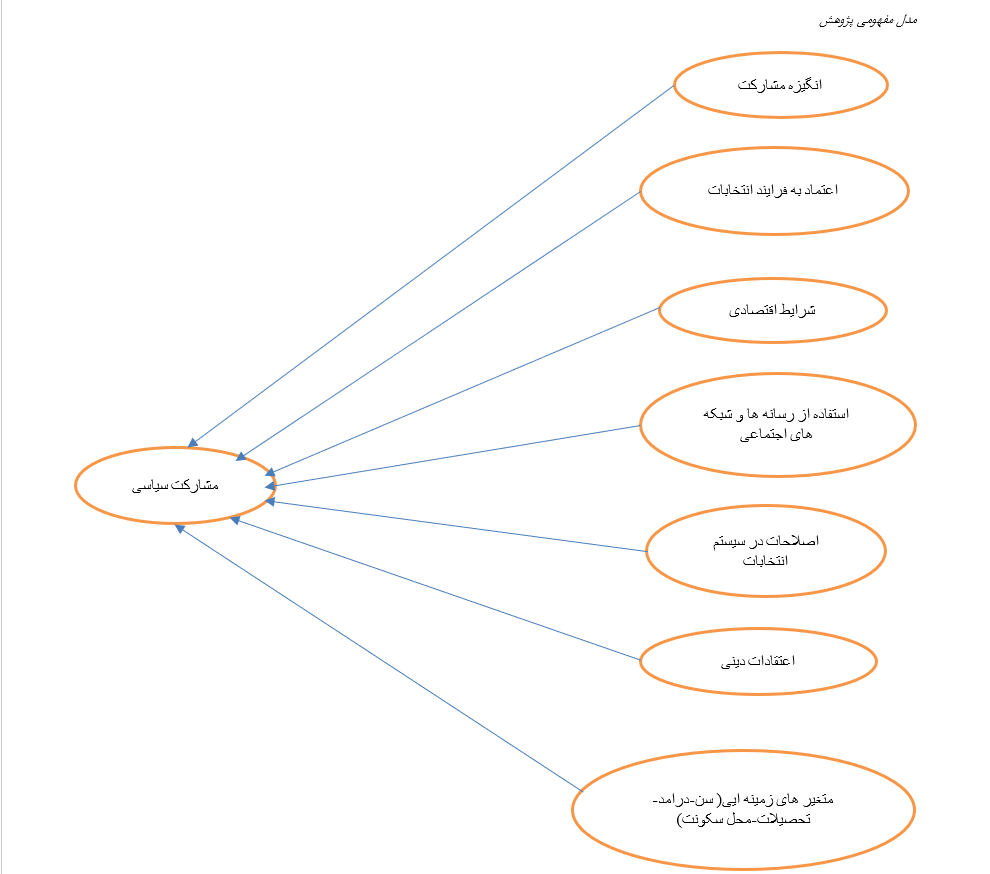
The present study was conducted to investigate the factors influencing the level of political participation among citizens of Tehran in the Thirteenth Presidential Election of Iran. This election experienced a substantial decline in voter turnout, with participation in Tehran falling to approximately 26 percent. The study employed a survey research design and utilized a researcher-developed questionnaire administered to a sample of 384 Tehran citizens selected through stratified random sampling from five municipal districts. The findings derived from structural equation modeling indicated that the most important and strongest determinant of political participation was trust in the electoral process (path coefficient = 0.642). Furthermore, the variables of religious beliefs, electoral system reforms, use of media and social networks, age, and education had positive and statistically significant effects on political participation. In contrast, economic conditions and income did not demonstrate significant direct effects. The variable of residential district exhibited a negative effect, indicating that residents of the deprived southern and eastern areas of Tehran participated less than residents of the northern and central districts. The research model explained 71 percent of the variance in political participation. Overall, the results suggest that the decline in participation in the election under study was primarily attributable to citizens’ distrust of the integrity, transparency, and impartiality of the electoral process rather than solely to economic difficulties. Therefore, rebuilding public trust through structural reforms in the electoral system—particularly by enhancing transparency and impartial oversight—as well as paying special attention to younger generations and residents of disadvantaged areas, appears essential for increasing participation in future electoral cycles.
Downloads
References
Almond, G. A., & Verba, S. (1963). The Civic Culture: Political Attitudes and Democracy in Five Nations. Princeton University Press.
Azadi, A. (1994). Political Awareness among Students of the University of Tehran and Allameh Tabataba'i University University of Tehran].
Azadi, A., Heidari, N., Fattahi, S., Beheshtinia, E., & Saeedynezhad, H. (2025). The Impact of Social Media and Cyberspace on Citizens' Electoral Behavior with an Emphasis on Political Participation in the 13th Presidential Election: In the Electoral Districts of Qasr-e Shirin, Sarpol-e Zahab, and Gilan-e Gharb. Journal of Psychological and Political Insights.
Bavar, S. (1995). Examining the Effect of the Economic and Social Status of Shiraz University Students on Their Attitudes toward Women's Political Participation Shiraz University].
Beck, P. A., & Jennings, M. K. (1970). Political Periods and Political Participation. American Political Science Review, 64(3), 737-749.
Beck, P. A., & Jennings, M. K. (1982). Pathways to Participation. American Political Science Review, 76(1), 94-108.
Bobo, L., & Gilliam, F. D. (1990). Race, Sociopolitical Participation, and Black Empowerment. American Political Science Review, 84(2), 377-393.
Brady, H. E., & Verba, S. (1995). Voice and Equality: Civic Voluntarism in American Politics. Harvard University Press.
Campbell, C., & Jovchelovitch, S. (2000). Health, Community and Development: Towards a Social Psychology of Participation. Journal of Community & Applied Social Psychology, 10(4), 255-270.
Chen, G., Li, X., & Zhang, Y. (2017). Social Media Use, Political Interest, and Participation among University Students in Guangzhou, China. Journal of Youth Studies, 20(5), 621-637.
Cho, W. K. T., & Rudolph, T. J. (2005). Geographical Clustering of Political Participation. Political Geography, 24(6), 723-748.
Clem, R. S., & Craumer, P. R. (1998). Regional Patterns of Voter Turnout in Russian Elections, 1993-1996. Post-Soviet Geography and Economics, 39(9), 497-523.
Crisis, G. (2021). Iran: The Riddle of Raisi.
Foundation for Defense of, D. (2024). Iranian Election Registers Lowest Voter Turnout since 1979.
Geys, B. (2006). Explaining Voter Turnout: A Review of Aggregate-Level Research. Electoral Studies, 25(4), 637-663.
Ghaffari Hashjin, Z., Rezaei, M., & Mohammadi, S. (2010). Factors Affecting Political Participation among Political Science and Engineering Students at the University of Tehran. Political Science Research Letter, 5(3), 91-112.
Goodarzifar, M., & Dinparast, F. (2024). The Impact of Judicial Branch Performance on the Reproduction of Political Trust in Iran. State Studies, 10(39), 253-288. https://tssq.atu.ac.ir/article_18303.html
Huntington, S. P., & Nelson, J. M. (1976). No Easy Choice: Political Participation in Developing Countries. Harvard University Press.
Inkeles, A. (1969). Participant Citizenship in Six Developing Countries. American Political Science Review, 63(4), 1120-1141.
Iranian Students Polling, A. (2003). Examining the Electoral Attitudes and Behavior of the People of Tehran before the Seventh Parliamentary Election.
Iranian Students Polling, A. (2005). Social Justice Discourse and Personal Characteristics: A Study on the Presidential Election.
Jemna, D. V., & Curelaru, M. (2009). Values and Political Participation of Students. Journal of Social Research, 13(2), 88-104.
Lipset, S. M. (1963). Political Man: The Social Bases of Politics. Doubleday.
Mehregan, N., & Ezzati, M. (2006). Examining the Impact of Different Factors on People's Participation in the Eighth Iranian Presidential Election: An Econometric Approach. Applied Economics Quarterly, 2(4), 51-70.
Milbrath, L. W. (1965). Political Participation: How and Why Do People Get Involved in Politics? Rand McNally.
Mohammadifar, N. (2025). The Role of Economic Development in Voting Behavior: Evidences from Iran's Presidential Elections. Iranian Journal of Economic Studies, 14(2), 527-546.
Mosaffa, N. (1994). Women's Political Participation Allameh Tabataba'i University].
Naderi, A. (2017). Meta-Analysis of Political Participation among Iranian Students: A Study of the Effectiveness of Explanatory Factors. Iranian Journal of Sociology, 18(1), 83-110.
Palizban, M. (2011). Examining Students' Tendency toward Political Participation and the Factors Affecting It. Political Science Quarterly, 14(2), 121-144.
Panahi, M. H. (2007). Political Participation: Theories, Models, and Analysis. Sociologists Publications.
Putnam, R. D. (2000). Bowling Alone: The Collapse and Revival of American Community. Simon & Schuster.
Rahimkhani, K. (2022). Political Opposition and Voter Mobilization in an Authoritarian State: The Case of Parliamentary Elections in Iran. British Journal of Middle Eastern Studies, 50(3), 636-653.
Razi, A. (2001). Examining the Social and Economic Factors Affecting People's Participation in the Six Presidential Elections after the Victory of the Islamic Revolution in Iran, 1979-1993 Tarbiat Modares University].
Rush, M. (1998). Society and Politics: An Introduction to Political Sociology (M. Sabouri, Trans.). SAMT Publications.
Sardarnia, K., Kazerouni, E., & Ghoreyshi, J. (2025). The Challenges of Governance in the Islamic Republic of Iran within Social Networks: The Case of Generation Z. Political Sociology of the Islamic Revolution, 5(4), 111-140.
Seyed Emami, K. (2007). Students' Political Participation: An Assessment of Some Predictors of Political Participation. Social Research Journal, 1(2), 45-68.
Seyed Emami, K., & Abdollah, M. (2009). Legitimacy and Acceptability of the Political System in Light of Electoral Participation. Political Studies Quarterly, 2(5), 1-22.
Verba, S., & Nie, N. H. (1965). Participation in America: Political Democracy and Social Equality. Harper & Row.
Wall, D. L., & Lehoucq, F. E. (1997). Urbanization, Education, and Voter Turnout in Guatemala. Electoral Studies, 16(2), 189-204.
Weiner, M., & Huntington, S. (2000). Political Participation (M. Mehraban, Trans.). Institute for Strategic Studies Publications.
Zaher, Z. (2016). Social Media Use and Political Participation among University Students in Pakistan. Journal of Media Studies, 31(2), 45-62.
Zipp, J. F., Landerman, R., & Luebke, P. (1979). Political Participation and the Social Bases of Politics: A Longitudinal Analysis. American Sociological Review, 44(6), 1140-1150.
Downloads
Publication Timeline
- Submitted
- Revised
- Accepted
Issue
Section
License
Copyright (c) 2025 Babak Ala (Author); Saeed Maadani (Corresponding Author); Rosa Karampour (Author)

This work is licensed under a Creative Commons Attribution-NonCommercial 4.0 International License.