A Comparative Study of the Role of Good Governance in Political Crisis Management during the Rouhani and Raisi Administrations
Keywords:
Good governance, political stability, centralization, decentralization, twelfth and thirteenth governmentsAbstract
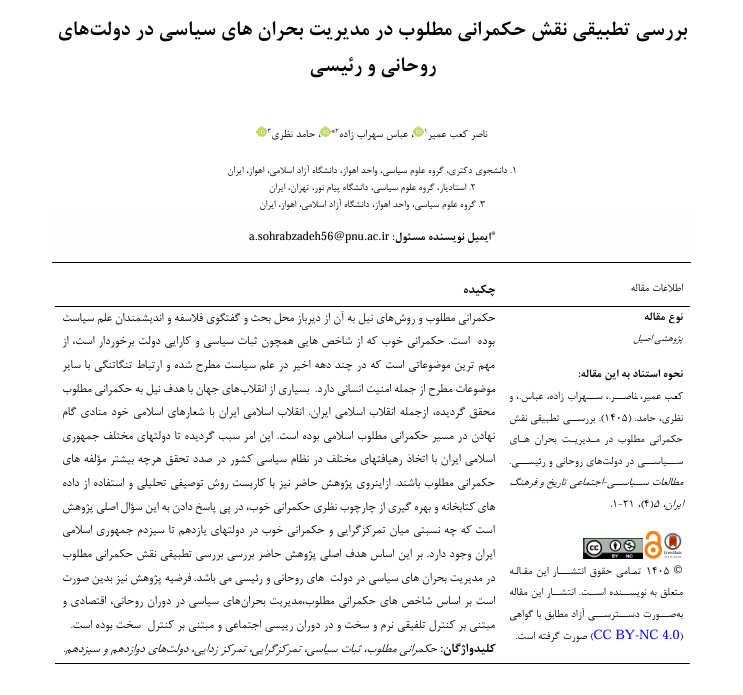
Good governance and the methods of achieving it have long been subjects of debate and discussion among philosophers and political science scholars. Good governance, characterized by indicators such as political stability and government effectiveness, is among the most important issues addressed in political science over the past several decades and is closely associated with other significant concepts, including human security. Many revolutions throughout the world have occurred with the objective of achieving good governance, including the Islamic Revolution of Iran. Through its Islamic slogans, the Islamic Revolution of Iran proclaimed a commitment to advancing toward Islamic good governance. This has led successive governments of the Islamic Republic of Iran to adopt different approaches within the country’s political system in an effort to realize the components of good governance to an increasing extent. Accordingly, employing a descriptive-analytical method, drawing on library-based data, and applying the theoretical framework of good governance, the present study seeks to answer the main research question: What relationship exists between centralization and good governance in the Eleventh through Thirteenth Administrations of the Islamic Republic of Iran? On this basis, the primary objective of the present study is to comparatively examine the role of good governance in political crisis management during the Rouhani and Raisi administrations. The research hypothesis holds that, based on the indicators of good governance, political crisis management during the Rouhani administration was primarily economic in orientation and based on a combination of soft and hard control mechanisms, whereas during the Raisi administration, it was primarily social in orientation and based on hard-control mechanisms.
Downloads
References
Asadi, M. (1992). Political-Administrative Centralization and Stages of Economic Growth. Economic Research, 31(46), 55-75.
Charlick, R. (1992). The Concept of Governance and Its Implications for A.I.D. Development Assistance.
Conyers, D. (1986). Future Direction in Development Studies: The Case of Decentralization. World Development, 593-603.
Dahl, R. A. (1982). Dilemmas of Pluralist Democracy: Autonomy vs. Control. Yale University Press.
Darabnia, S. (2022). Examining the Relationship Between Good Governance Indicators and Human Security. Quarterly Journal of Social Development, 17(2), 47-78.
Foroughi Abri, A. A., & Sahami, F. (2014). Examining and Analyzing Factors Affecting Centralization in Contemporary Iranian History During the Constitutional Revolution and the Islamic Revolution. Quarterly Journal of Zharfapazhouh, 2(2-3).
Ghaffari, M., & Rostampour, M. (2021). The Relationship Between Centralization and Good Governance in Iran's Ninth and Tenth Governments. Political Research of the Islamic World, 11(1).
Ghasouri, S., & Ghasemi Ghoncheh Nazi, M. (2020). Estimating the Consumption of Essential Goods in the Country: 2011-2021.
Landell-Mills, P., & Serageldin, I. (1991). Governance and the External Factor World Bank Annual Conference, Washington.
Makvandi, F. (2018). Citizens' Perceptions of Political Stability and Political Turnover Indicators in Good Governance Based on Indigenous Components of Urban Service Organizations in Iran: A Case Study of Government Organizations in Khuzestan Province. Quarterly Journal of Organizational Culture Management, 16(4).
Moradi, M. (2017). Study and Comparison of Government Financial Accountability in Four Presidential Periods After the Islamic Revolution Using Critical Discourse Analysis. Management Journal, 9(2).
Mousazadeh, R. (2008). Administrative Law 1 and 2. Mizan.
Nadeem, M. (2016). Analyzing Good Governance and Decentralization in Developing Countries.
Noudijeh, H. A. (2021). Analysis of the Political-Economic Policies of Post-Revolutionary Iranian Governments Based on the Good Governance Model: A Case Study of Hassan Rouhani's Government. Quarterly Journal of Political and International Research, 12(49).
Omidi, A. (2013). Security, Sustainable Development, and Strengthening the Rule-Based Functioning of Local Governments in Iran. Quarterly Journal of Geographical Research, 28(4), 113-136.
Rahami, R. (2016). Human Security and the State: Freedom from Fear, Freedom from Want in the Developmental Social State. Mizan.
Rahnejat, M. (2024). Evaluation of Good Governance Requirements in the Foreign Policy of Iran's Thirteenth Government. Scientific Quarterly of Governance Knowledge, 2(2).
Rondelli, D. (1984). Decentralization in Developing Countries.
Sadeghi, S. (2021). Examining Macroeconomic Indicators During Hassan Rouhani's Presidency. https://www.eghtesadnews.com
Safarian, R. (2019). The Good Governance Model and Economic Development in Iran and Turkey, 2006-2017. Quarterly Journal of Political and International Approaches, 11(2).
Samiei Esfahani, A. (2021). Explaining the Dimensions and Components of the Rouhani Government's Security Approach Based on Copenhagen School Theory. Quarterly Journal of Strategic Political Research, 10(39).
Shabafrouz, N. (2023). Examining and Analyzing Intertwined Crises in Hassan Rouhani's Government and Their Consequences for Political Participation (2013-2021). Strategic Political Research, 11(45).
Shiroudi, M. (2008). Centralization and Political Development in Contemporary Iranian History. Quarterly Journal of Islamic Revolution Studies, 4, 49-83.
Taheri, S. (2019). What Are the Manifestations of Government Inefficiency from the Perspective of Economics? https://www.tejaratefarda.com/
Vengroff, R., & Salem, B. H. (1992). Assessing the Impact of Decentralization on Governance: A Comparative Methodological Approach and Application to Tunisia. Public Administration and Development, 12, 473-492.
Zahedi Vafa, M. H. (2019). Explanation and Ranking of Government Efficiency and Effectiveness Indicators in Islamic Economics. Biannual Journal of Islamic Economics Studies, 12(1).
Zarei, M., & Araei, V. (2021). Analysis and Critique of the Good Governance Model: Explaining Islamic Governance Based on the Constitution of the Islamic Republic of Iran. Quarterly Journal of Islamic Revolution Research, 10(2).
Zarrati, M. (2023). An Analysis of the Security and Economic Consequences of Iran's Membership in the Shanghai Cooperation Organization. Quarterly Journal of Defense Economics and Sustainable Development, 8(27).
Downloads
Publication Timeline
- Submitted
- Revised
- Accepted
Issue
Section
License
Copyright (c) 2025 Nasser Kaab Omair (Author); Abbas Sohrabzadeh; Hamed Nazari (Author)

This work is licensed under a Creative Commons Attribution-NonCommercial 4.0 International License.