An Examination of the Causes of the Failure of Iran’s Fifth Development Plan from the Perspective of Public Policy Implementation Research
Keywords:
Fifth Development Plan, Implementation Research, Public Policy, Policy Implementation, Development Planning, Thematic AnalysisAbstract
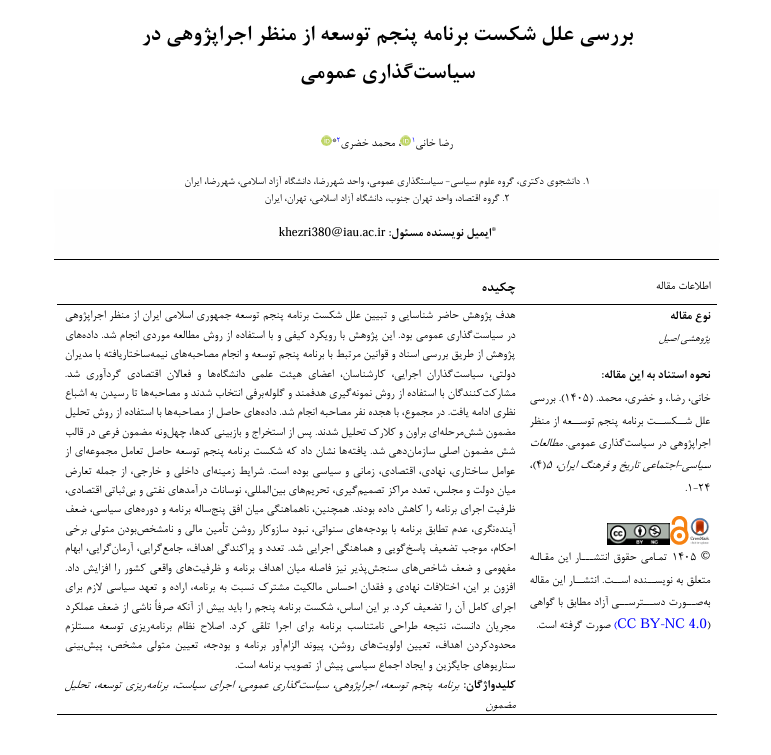
The present study aimed to identify and explain the causes of the failure of the Fifth Development Plan of the Islamic Republic of Iran from the perspective of public policy implementation research. The study adopted a qualitative case-study design. Data were collected through the examination of legal and policy documents related to the Fifth Development Plan and semi-structured interviews with government managers, executive policymakers, experts, university faculty members, and economic actors. Participants were selected through purposive and snowball sampling, and the interviews continued until theoretical saturation was achieved. In total, eighteen individuals participated in the interviews. The interview data were analyzed using Braun and Clarke’s six-stage thematic analysis method. Following coding, review, and categorization, forty-nine subsidiary themes were organized into six main themes. The findings indicated that the failure of the Fifth Development Plan resulted from the interaction of structural, institutional, economic, temporal, and political factors. Internal and external contextual conditions, including conflict between the government and parliament, the multiplicity of decision-making centers, international sanctions, fluctuations in oil revenues, and economic instability, substantially reduced the implementation capacity of the Plan. In addition, the inconsistency between the five-year policy horizon and political cycles, inadequate foresight, weak alignment between the Plan and annual budgets, the absence of clear financing mechanisms, and the lack of clearly designated executive authorities weakened accountability and administrative coordination. The multiplicity and dispersion of objectives, excessive comprehensiveness, idealistic goal setting, conceptual ambiguity, and the weakness of measurable indicators further widened the gap between the Plan’s ambitions and the country’s actual capacities. Institutional disagreements and the absence of shared ownership also undermined the political will and commitment required for comprehensive implementation. Accordingly, the failure of the Fifth Development Plan should be understood not merely as a consequence of poor executive performance, but as the result of inadequate design for implementation. Reforming development planning requires limiting the number of objectives, establishing clear priorities, creating a binding relationship between development plans and annual budgets, assigning specific executive responsibility, preparing alternative scenarios, and securing political consensus before the final approval of development plans.
Downloads
References
Abedi Jafari, H., Taslimi, M. S., Faghihi, A., & Sheikhzadeh, M. (2011). Thematic Analysis and Thematic Networks: A Simple and Efficient Method for Explaining Patterns in Qualitative Data. Strategic Management Thought(2).
Barrett, S. M., & Fudge, C. (1981). Policy, Bargaining and Structure in Implementation Theory. Policy and Politics, 12, 3.
Braun, V., & Clarke, V. (2006). Using thematic analysis in psychology. Qualitative research in psychology, 3(2), 77-101.
Brynard, P. (2005). Policy implementation: Lessons for service delivery. 27th AAPAM Annual Round Table Conference, Livingstone, Zambia.
Denhardt, R. B. (2003). Theories of Public Organizations (2nd ed.). Saffar Publications.
Eshterian, K., Keshvardoust, S., Asadi Kesheh, A. A., & Panahi, M. A. (2017). Implementation Research: Challenges of Public Policy Implementation in Iran. Policy-Maker Publications.
Hogwood, B. W., & Gunn, L. A. (1984). Policy Analysis for the Real World. Oxford University Press.
Jahangard, E., & Varmaziar, H. (2012). A Collection of Studies on the Desired Planning Model for Iran: A Comparative Study of Iran's Planning Systems During Development Plans Before and After the Islamic Revolution.
Mazmanian, D. A., & Sabatier, P. A. (1983). Implementation and Public Policy. Scott, Foresman.
Pressman, J. L., & Wildavsky, A. (1973). Implementation: How Great Expectations in Washington Are Dashed in Oakland; or, Why It's Amazing that Federal Programs Work at All. University of California Press.
Pressman, J. L., & Wildavsky, A. (1983). Implementation. University of California Press.
Pülzl, H., & Treib, O. (2007). Implementing Public Policy. In F. Fischer, G. J. Miller, & M. S. Sidney (Eds.), Handbook of Public Policy Analysis (pp. 89-103). University of California Press.
Sabatier, P. A. (1986). Top-Down and Bottom-Up Models of Policy Implementation: A Critical Analysis and Suggested Synthesis. Journal of Public Policy, 6, 21-48.
Van Meter, D. S., & Van Horn, C. E. (1975). The Policy Implementation Process: A Conceptual Framework. Administration & society, 6.
Downloads
Publication Timeline
- Submitted
- Revised
- Accepted
Issue
Section
License
Copyright (c) 2025 Reza Khani (Author); Mohammad Khezri (Corresponding Author)

This work is licensed under a Creative Commons Attribution-NonCommercial 4.0 International License.