The Role of Cognitive Warfare in Modern Military Strategies in Iran: From Battlefield Combat to the Battle of Narratives
Keywords:
cognitive warfare, modern military strategy, battlefield combat, battle of narratives, media crisis managementAbstract
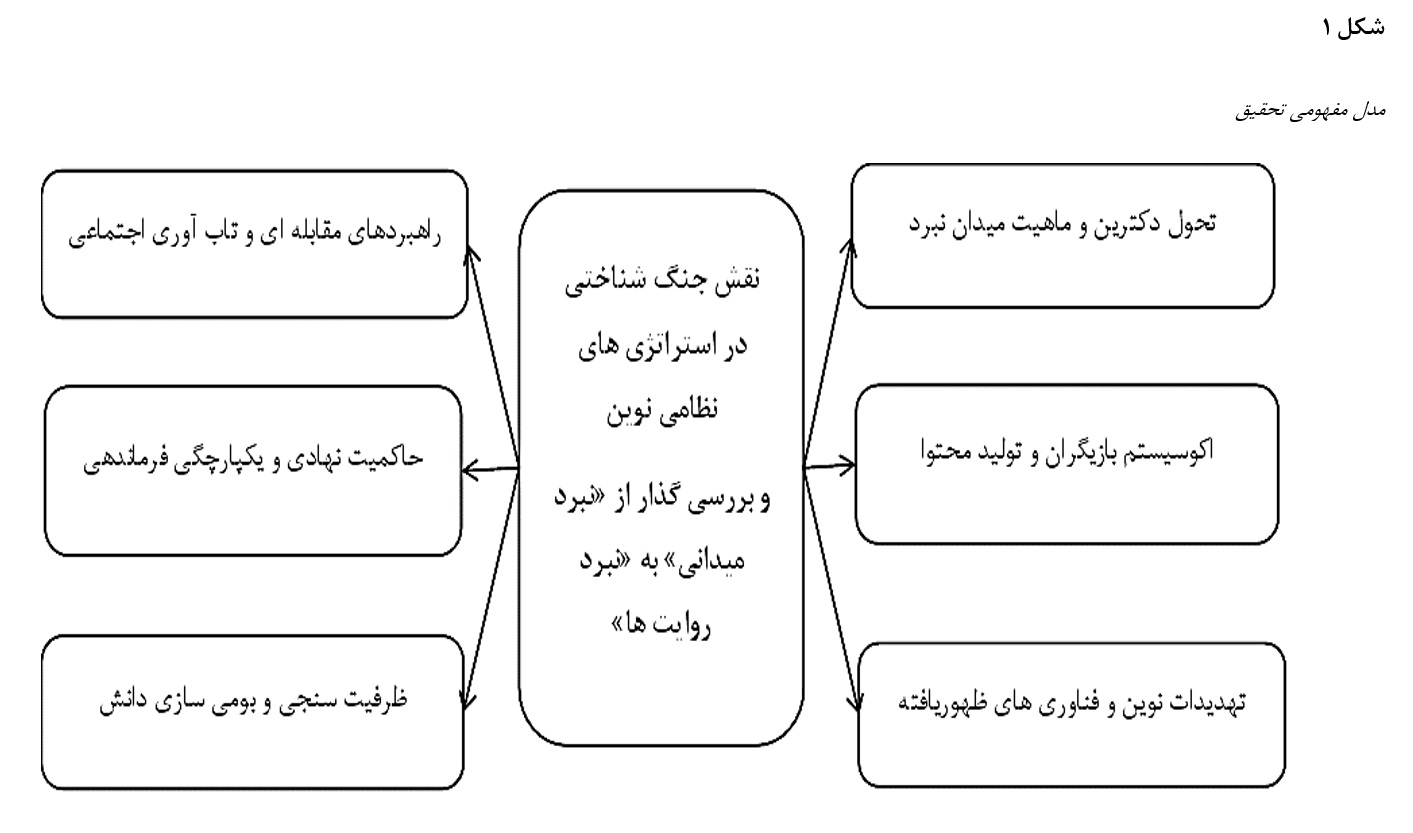
This study aimed to examine the role of cognitive warfare in the modern military strategies of the Islamic Republic of Iran and to investigate the transition from battlefield combat to the battle of narratives. The study was conducted using a qualitative approach and the thematic analysis method. Professors of defense and strategic studies, cognitive warfare analysts in security think tanks, and specialists in political communication and social psychology were considered the statistical population and research experts. The sampling method was snowball sampling, and the researcher reached theoretical saturation through semi-structured interviews with 16 experts. Following open, axial, and selective coding, the findings indicated that Iran’s defense doctrine has undergone a paradigmatic transformation and is shaped by six main themes: “transformation of doctrine and the nature of the battlefield,” “counterstrategies and social resilience,” “the ecosystem of actors and content production,” “institutional governance and command integration,” “emerging threats and emergent technologies,” and “capacity assessment and indigenization of knowledge.” This means that national security is no longer merely physical; rather, it is grounded in the management of meaning, intelligent monitoring of public opinion, the use of digital elites, and confrontation with artificial intelligence threats. In addition, challenges such as interinstitutional lack of coordination, the shortage of indigenous models, and weaknesses in the quantitative measurement of effectiveness were identified as implementation barriers. The final conclusion indicates that success in the battle of narratives requires the establishment of unified cognitive command headquarters, the enhancement of citizens’ media literacy, and a transition from qualitative judgments to data-driven and quantitative evaluations in order to strengthen national resilience against hybrid warfare.
Downloads
References
Alizadeh Gorji, M., & Seyedi, S. (2024). Explaining cognitive warfare from the perspective of leaders, managers, and military commanders. 2nd National Conference on Command and Management in Future Wars with a Cognitive Approach, Tehran.
Ayhan, U. (2026). The architecture of narrative dominance: Confronting data terror and the rise of cognitive warfare. In Navigating Public Security in the Age of Post-Truth: Challenges and Implications (pp. 1-26). IGI Global Scientific Publishing.
Claverie, B., & Du Cluzel, F. (2022). Cognitive warfare: The advent of the concept of cognitics in the field of warfare. In Cognitive Warfare: The Future of Cognitive Dominance (pp. 1-2).
Dadashi Haji, M., & Ghanbari, V. (2025). Algorithmic cognitive warfare: The role of artificial intelligence in the battlefield of the mind. 2nd National Conference on Emerging and Disruptive Sciences and Technologies in the Defense Field, Tehran.
Eshrat-abadi, M., Hassan, & Shakuri Moghani, S. (2022). Modern cognitive warfare: From the application of cognitive science and technology in the battlefield to the arena of cognitive warfare. Journal of Human Resource Studies, 12(2), 156-180.
Farhadi, A., Hamedi Sanjabi, A., & Tabarzad, M. S. (2024). Presenting a model of cognitive anti-fragility of the Armed Forces of the Islamic Republic of Iran in confronting the enemy's cognitive warfare. Strategic Management Approach Quarterly, 2(4), 177-202.
Farrokhi Afsharian, M. (2024). Cognitive weapons and their use in cognitive warfare: A systematic review. National Conference on Cognitive Warfare: Science and Technology, Tehran.
Ghanbarian, P., & Fakouri, F. (2024). Explaining the dimensions and components of cognitive warfare. National Conference on the Arena of Cognitive Warfare: Science and Technology, Tehran.
Kolivand, K., Nasirzadeh, A., & Khadem Daghigh, A. H. (2025). Identifying and explaining cognitive-warfare drivers affecting command-and-control systems in future battles.
Komasi, M., & Abdoli, A. (2024). Cognitive warfare: Analysis of ethical and strategic dimensions in the use of misinformation. National Conference on the Arena of Cognitive Warfare: Science and Technology, Tehran.
Mahjoub, H., & Shakouri, S. (2022). Modern cognitive warfare: From cognition in combat to the arena of cognitive warfare. Human Resource Studies, 12(2), 156-180.
Marjanovic, A., & Smiljanic, D. (2025, 2025/04). Cognitive warfare: The human mind as the new battlefield. Proceedings of the Defence and Security Conference,
Masakowski, Y. R., & Sivertsen, E. G. (2023). Defence against 21st century cognitive warfare: Considerations and implications of emerging advanced technologies. In Mitigating and Responding to Cognitive Warfare (pp. 1-12).
Mehranian, S., Rahmanzadeh, S. A., Ahmadi, S., & Taghipour, F. (2025). Advertising strategies in confronting cognitive warfare: Designing a preventive model. Social Development, 20(2), 201-230.
Melas-Fragkiskos, P. (2026). Cognitive Warfare in the Digital Age: Strategies, Implications and the Battle for the Human Mind Athens University of Economics and Business].
Salehi, E. (2024). Cognitive warfare: The impact of emerging technologies on military strategies and ethical challenges in the digital age. National Conference on the Arena of Cognitive Warfare: Science and Technology, Tehran.
Santos, C. P. (2025). Cognitive warfare: The mind as a battlefield. Eksplorium-Buletin Pusat Teknologi Bahan Galian Nuklir, 46(1), 1243-1270.
Downloads
Publication Timeline
- Submitted
- Revised
- Accepted
Issue
Section
License
Copyright (c) 2025 آتنا حسنی خواجه پاشا (نویسنده مسئول)

This work is licensed under a Creative Commons Attribution-NonCommercial 4.0 International License.