Iranians’ Views of Russians and the English before the Nineteenth Century: From Suspicion to Admiration
DOI:
https://doi.org/10.61838/kman.jspsich.546Keywords:
Pre-Qajar Iran, Russia, England, Safavid Iran, Persian Gulf, Caucasus, Iranian foreign relations, historical perceptionAbstract
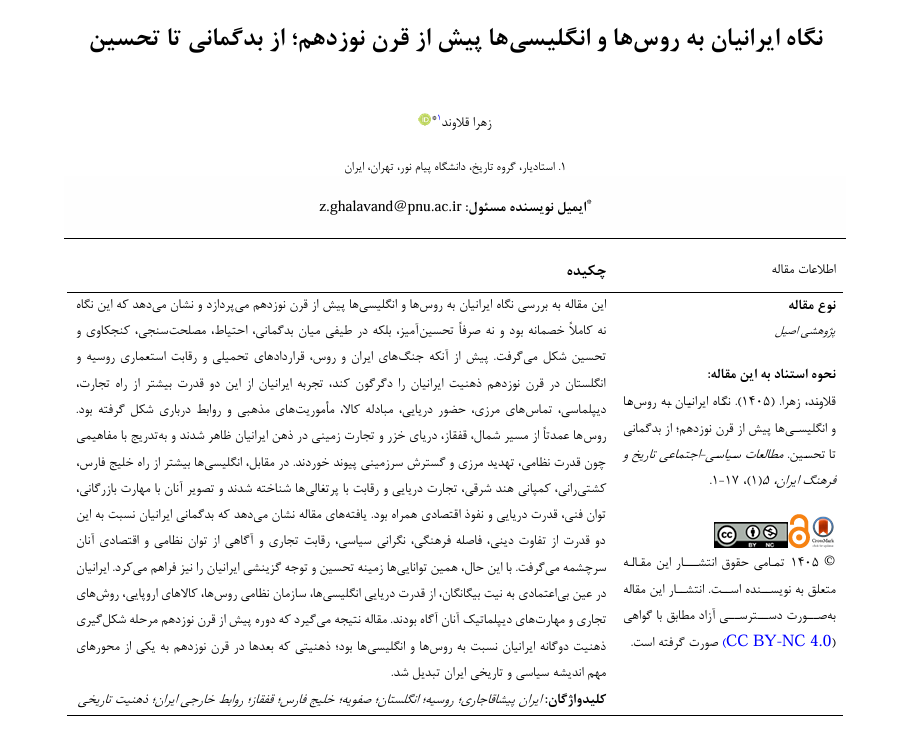
This article examines Iranian perceptions of Russians and the English before the nineteenth century and argues that these perceptions were neither entirely hostile nor simply admiring. Rather, they developed within a spectrum of suspicion, caution, pragmatism, curiosity, and selective admiration. Before the Russo-Iranian wars, imposed treaties, and intensified Anglo-Russian imperial rivalry transformed Iranian political consciousness in the nineteenth century, Iranian experiences of these two powers were shaped mainly through trade, diplomacy, border contacts, maritime presence, commodity exchange, missionary activity, and courtly relations. Russians entered Iranian perception primarily through the northern frontier, the Caucasus, the Caspian Sea, and overland commerce, and gradually became associated with military power, border anxiety, and territorial expansion. By contrast, the English were known largely through the Persian Gulf, navigation, the East India Company, maritime trade, and rivalry with the Portuguese; their image was connected to commercial skill, technical capacity, naval power, and economic influence. The findings indicate that Iranian suspicion toward both powers derived from religious difference, cultural distance, political anxiety, commercial competition, and awareness of their military and economic capabilities. Yet these same capabilities also generated admiration and selective attention. Iranians distrusted foreign intentions, but they also recognized English maritime strength, Russian military organization, European goods, commercial methods, and diplomatic skill. The article concludes that the pre-nineteenth-century period was a formative stage in the emergence of a dual Iranian mentality toward Russians and the English. These powers were viewed simultaneously as useful and dangerous, impressive and suspect, culturally distant yet practically significant. This dual perception later became one of the major foundations of nineteenth-century Iranian political and historical thought, especially as Russian expansion and British influence became increasingly central to Iran’s foreign relations.
Downloads
References
Amiri, H. (2001). Foreign Trade in the Safavid Period. History of Foreign Relations Quarterly, 2(7-8).
Arab-Hashemi, S. a.-S. (2004). The Role of Armenians in Safavid Foreign Trade. In M.-A. Sadeqi (Ed.), Iran in the Scope of Safavid History. Sotudeh.
Atkin, M. (1980). Russia and Iran, 1780-1828. University of Minnesota Press.
Falsafi, N. (1966). The Life of Shah Abbas I. University of Tehran Press.
Ferrier, R. W. (1985). Anglo-Iranian Relations i. Safavid to Zand Periods. Encyclopaedia Iranica. https://www.iranicaonline.org/articles/anglo-iranian-relations-i/
Floor, W. (2006). The Persian Gulf: A Political and Economic History of Five Port Cities, 1500-1730. Mage Publishers.
Hessam Moezzi, N. (1987). History of Iran's Political Relations with the World. Elm.
Houshang Mahdavi, A. (1990). History of Iran's Foreign Relations from the Beginning of the Safavid Period to the End of the Second World War. Amir Kabir.
Jamalzadeh, M. A. (2005). History of Relations between Russia and Iran. Sokhan.
Jenkinson, A. (1886). Early Voyages and Travels to Russia and Persia by Anthony Jenkinson and Other Englishmen. Hakluyt Society.
Kajbaf, A.-A., Dehqan-Nezhad, M., & Cheraghchi, Q. (2018). Examining the Dimensions of Developments in Iran-Russia Relations during the Safavid Period. Historical Researches of the University of Isfahan, 10(1), 1-18.
Mahmoud, M. (1949). History of Political Relations between Iran and England in the Nineteenth Century. Eqbal.
Matthee, R. (1994). Anti-Ottoman Politics and Transit Rights: The Seventeenth-Century Trade in Silk between Safavid Iran and Muscovy. Cahiers du Monde Russe, 35(4), 739-761. https://doi.org/10.3406/cmr.1994.2405
Matthee, R. (1998). Europe, Persian Image of. Encyclopaedia Iranica. https://www.iranicaonline.org/articles/europe-persian-image-of/
Matthee, R. P. (1999). The Politics of Trade in Safavid Iran: Silk for Silver, 1600-1730. Cambridge University Press.
Monshi, E. B. (1978). History of Shah Abbas the Great: Tarikh-e Alam-ara-ye Abbasi. Westview Press.
Nava'i, A. (1991). Iran and the World from the Mongols to the Qajars. Homa Publishing Institute.
Nava'i, A. (1993). Political Relations between Iran and Europe in the Safavid Era. Wisman.
Nava'i, A. (1998). Political and Economic Relations of Iran in the Safavid Period. SAMT.
Ranjbar, M. A., Tavakolian, A., & Mousavi, A. (2012). Iran-Russia Commercial Relations in the Second Period of Safavid Rule, 996-1135 AH / 1588-1723 CE. History of Foreign Relations Quarterly, 13(51), 57-78. https://doi.org/20.1001.1.17352010.1391.13.51.3.1
Shabani, R. (1986). Social History of Iran in the Afsharid Era.
Sotudeh, M. (2004). Documents of the Carmelite Fathers Remaining from the Age of Shah Abbas. Written Heritage Research Institute.
Taheri, A. (1975). History of Commercial and Political Relations between England and Iran: From the Rule of the Mongols to the End of the Qajar Period. Society for National Heritage.
Downloads
Publication Timeline
- Submitted
- Revised
- Accepted
Issue
Section
License
Copyright (c) 2026 زهرا قلاوند (نویسنده مسئول)

This work is licensed under a Creative Commons Attribution-NonCommercial 4.0 International License.