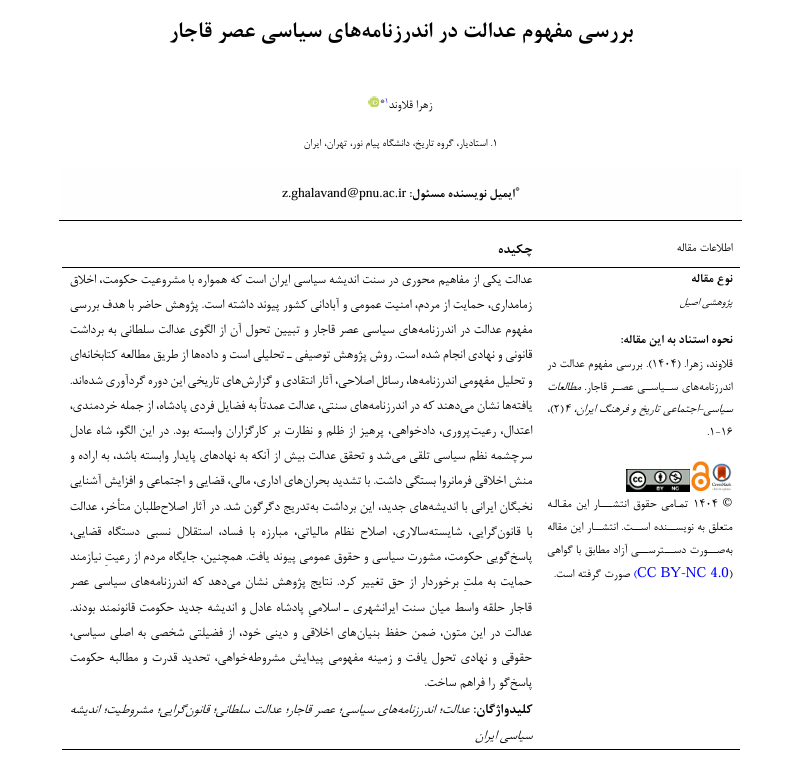
An Examination of the Concept of Justice in Political Advice Literature of the Qajar Era
DOI:
https://doi.org/10.61838/kman.jspsich.556Keywords:
Iranian Political Thought, Constitutionalism, Justice, Rule of Law, Royal Justice, Qajar Era, Political Advice LiteratureAbstract
Justice is one of the central concepts in the Iranian tradition of political thought and has historically been associated with governmental legitimacy, the ethics of rulership, protection of the population, public security, and the prosperity of the realm. This study examines the concept of justice in Qajar-era political advice literature and explains its transformation from a sovereign-centered model into a legal and institutional conception. The study employs a descriptive-analytical method based on library research and the conceptual analysis of political advice texts, reformist treatises, critical writings, and historical accounts associated with the Qajar period. The findings demonstrate that traditional political advice literature primarily connected justice with the personal virtues of the monarch, including wisdom, moderation, protection of the subjects, responsiveness to grievances, avoidance of oppression, and supervision of governmental officials. Within this model, the just shah was regarded as the principal source of political order, while the realization of justice depended more on the ruler’s moral character and personal will than on stable institutions. This understanding gradually changed as administrative, fiscal, judicial, and social crises intensified and Iranian intellectuals became increasingly familiar with modern political ideas. In later reformist writings, justice became associated with the rule of law, merit-based administration, fiscal reform, opposition to corruption, relative judicial autonomy, governmental accountability, political consultation, and public rights. At the same time, the political status of the population evolved from subjects dependent on royal protection to members of a nation possessing recognizable rights. The study concludes that Qajar political advice literature constituted an intellectual bridge between the Iranian-Islamic tradition of the just ruler and the modern conception of lawful government. Although justice retained its ethical and religious foundations, it gradually developed from a personal virtue into a political, legal, and institutional principle, thereby contributing to the conceptual emergence of constitutionalism, limitations on political authority, and demands for accountable government in Iran.
Downloads
References
Adamiyat, F. (1961). The Idea of Freedom and the Prelude to the Iranian Constitutional Movement.
Adamiyat, F. (1969). Amir Kabir and Iran (3rd ed.).
Adamiyat, F. (1972). The Idea of Progress and the Rule of Law: The Sepahsalar Era.
Adamiyat, F. (1986). The Political and Social Thought of Talebof.
Adamiyat, F., & Nateq, H. (1977). Social, Political, and Economic Ideas in Unpublished Works of the Qajar Period.
Ajoudani, M. (1997). Iranian Constitutionalism. Fasl-e Ketab.
Amanat, A. (1997). Pivot of the Universe: Nasir al-Din Shah Qajar and the Iranian Monarchy, 1831-1896. University of California Press.
Arjomand, S. A. (1988). The Turban for the Crown: The Islamic Revolution in Iran. Oxford University Press.
Bakhash, S. (1978). Iran: Monarchy, Bureaucracy, and Reform under the Qajars, 1858-1896. Ithaca Press.
Dawlatabadi, Y. (1957). The Life of Yahya.
Floor, W. (1983). Changes and Developments in the Judicial System of Qajar Persia, 1800-1925. In C. E. Bosworth & C. Hillenbrand (Eds.), Qajar Iran: Political, Social and Cultural Change, 1800-1925 (pp. 113-147). Edinburgh University Press.
Hairi, A.-H. (1977). Shi'ism and Constitutionalism in Iran: A Study of the Role Played by the Persian Residents of Iraq in Iranian Politics. Brill.
Kasravi, A. (1940). The History of the Iranian Constitutional Revolution.
Lambton, A. K. S. (1987). Qajar Persia: Eleven Studies. I.B. Tauris.
Majd al-Molk Sinaki, M. K. (1977). The Majdiyya Treatise.
Malkom Khan, M. (1962). The Hidden Booklet, or the Book of Reforms.
Maraghe'i, Z. a.-A. (1895). The Travel Diary of Ebrahim Beg.
Mostashar al-Dowleh, M. Y. K. (1907). One Word.
Naini, M. H. (1909). The Admonition and Refinement of the Community.
Nazem al-Islam Kermani, M. (1947). The History of the Awakening of the Iranians.
Talebof Tabrizi, A. a.-R. (1894). The Book of Ahmad, or the Talebi Ship.
Talebof Tabrizi, A. a.-R. (1905). The Pathways of the Virtuous.
Downloads
Publication Timeline
- Submitted
- Revised
- Accepted
Issue
Section
License
Copyright (c) 2025 Zahra Ghalavand (Corresponding Author)

This work is licensed under a Creative Commons Attribution-NonCommercial 4.0 International License.