The Role and Position of the Clergy in the Political and Legal Structure of the Islamic Republic of Iran
Keywords:
Clergy, Political Structure, Legal Structure, Velayat-e-Faqih, Islamic Republic of IranAbstract
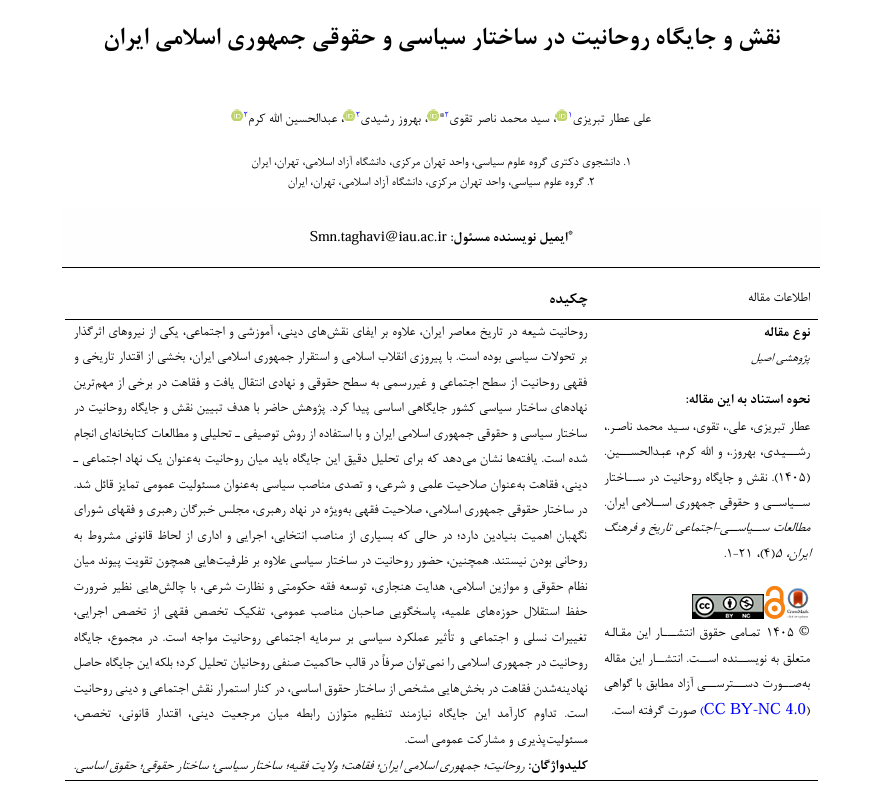
The Shiʿi clergy has played an influential role in modern Iranian history beyond its religious, educational, and social functions, particularly in major political transformations. Following the Islamic Revolution and the establishment of the Islamic Republic of Iran, part of the clergy’s historical and jurisprudential authority moved from the predominantly social and informal sphere into formal legal and institutional structures, while jurisprudential competence acquired a significant position within several major institutions of the political system. This study aims to explain and analyze the role and position of the clergy in the political and legal structure of the Islamic Republic of Iran through a descriptive-analytical method based on library research. The findings indicate that an accurate analysis requires a distinction among the clergy as a socio-religious institution, jurisprudential competence as a form of scholarly and religious qualification, and the holding of political office as a public responsibility. Within the constitutional structure of the Islamic Republic, jurisprudential qualifications are particularly significant in the institutions of the Supreme Leadership, the Assembly of Experts, and the juristic component of the Guardian Council, whereas many elected, executive, and administrative offices do not legally require clerical status. Clerical participation in the political system also entails important capacities, including strengthening the relationship between the legal order and Islamic norms, providing normative guidance, developing governmental jurisprudence, and ensuring religious supervision. At the same time, it generates challenges concerning the independence of the seminaries, the accountability of public officeholders, the distinction between jurisprudential and executive expertise, generational and social transformations, and the effects of political performance on the clergy’s social legitimacy. The study concludes that the clergy’s position in the Islamic Republic cannot adequately be characterized as a simple form of clerical monopoly over government. Rather, it reflects the constitutional institutionalization of jurisprudential authority within specific areas of the political system alongside the continuing social and religious functions of the clergy. Its sustainable effectiveness depends on maintaining a balanced relationship among religious authority, legal power, professional expertise, public accountability, and political participation.
Downloads
References
Algar, H. (1986). Religion and State in Iran: 1785-1906. University of California Press.
Arjomand, S. A. (1984). From Nationalism to Revolutionary Islam. Macmillan Press LTD.
Darabi, A. (2020). Political Currentology in Iran. Institute for Islamic Culture and Thought.
Fakhrzare, S. H. (2013). Social-Political Currentology of the Clergy. Quarterly Journal of Islam and Social Studies, 1(1), 7-34.
Farati, A. (2014). The Clergy and Modernity: With Emphasis on the Intellectual-Political Currents of the Qom Seminary. Research Center for Political Sciences and Thought.
Farati, A. (2019). The Interaction of the Clergy with the Islamic System: Explanations and Models. Publishing Organization of the Institute for Islamic Culture and Thought.
Firahi, D. (2013). Jurisprudence and Politics in Contemporary Iran: Political Jurisprudence and Constitutional Jurisprudence. Ney Publishing.
Ghoochani, M. (2023). The Crisis of the Islamic Bourgeoisie. Sarai Publishing.
Jafarian, R. (2008). Religious-Political Currents and Organizations in Iran: From the Accession of Mohammad Reza Shah to the Victory of the Revolution. Khaneh Ketab.
Mozaffari, A. (2008). Relations between the Clergy and the State in Contemporary Iran: A Political-Sociological Approach. Daftar-e Nashr-e Maaref.
Sindawi, K. (2007). Hawza Instruction and Its Role in Shaping Modern Identity: The Hawzas of al-Najaf and Qum as a Case Study. Middle Eastern Studies, 43(6), 831-856. https://doi.org/10.1080/00263200701607410
Tabatabaeifar, M. (2022). The Qom Seminary and the Political. Islamic Revolution Documents Center.
Taghavi, S. M. N. (2012). Religion and Democratic Foundations. Publishing Organization of the Institute for Islamic Culture and Thought.
Downloads
Publication Timeline
- Submitted
- Revised
- Accepted
Issue
Section
License
Copyright (c) 2025 Ali Attar Tabrizi (Author); Seyyed Mohammad Naser Taghavi; Behroz Rashidi , Abdol-Hossein Allah Karam (Author)

This work is licensed under a Creative Commons Attribution-NonCommercial 4.0 International License.