Explaining the Effects of Social, Cultural, and Political Factors on Economic Performance and Welfare in Iran
Keywords:
Iran, Welfare, Economic Performance, Political Factors, Cultural Factors, Social FactorsAbstract
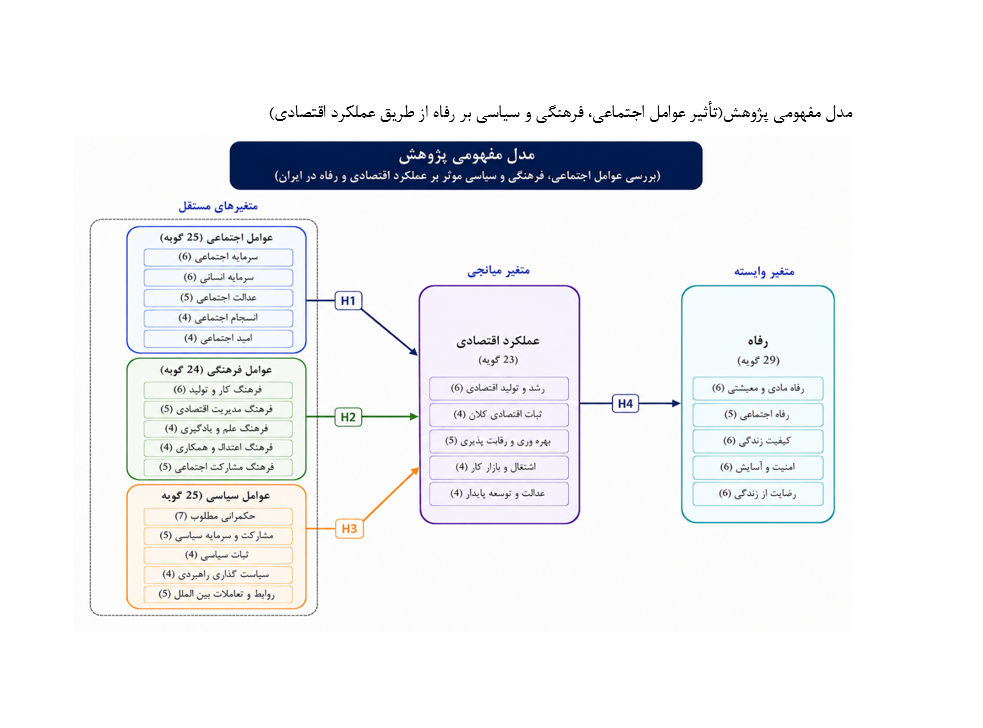
This study aimed to explain and empirically validate the effects of social, cultural, and political factors on welfare in Iran, with particular emphasis on the mediating role of economic performance and the development of an integrated model appropriate to the Iranian context. This applied study employed an exploratory sequential mixed-methods design within a pragmatic paradigm. In the qualitative phase, 20 senior economic managers, social welfare managers, government policymakers, and academic experts were selected purposively until theoretical saturation. Semi-structured interview data were analyzed through thematic analysis using NVivo, yielding 517 initial codes, 189 basic themes, 25 main categories, and five core themes. In the quantitative phase, 390 valid questionnaires were analyzed from a population of approximately 5,000 relevant managers, academics, researchers, experts, and specialists. A 126-item researcher-developed questionnaire measured social, cultural, and political factors, economic performance, and welfare. Content and construct validity were examined through expert assessment and confirmatory factor analysis, while reliability was evaluated using Cronbach’s alpha and construct reliability indices. Data were analyzed using SPSS and AMOS, and hypotheses were tested through structural equation modeling. Structural equation modeling demonstrated that social factors (β = 0.67), political factors (β = 0.59), and cultural factors (β = 0.52) exerted positive and statistically significant effects on economic performance, with social factors showing the strongest effect. Economic performance significantly predicted welfare (β = 0.81). Collectively, social, cultural, and political factors explained 73% of the variance in economic performance, while economic performance explained 66% of the variance in welfare. Significant indirect effects on welfare through economic performance were observed for social (β = 0.54), political (β = 0.48), and cultural factors (β = 0.42), confirming the mediating role of economic performance. Sustainable welfare in Iran depends on the coordinated strengthening of social capacities, development-oriented cultural orientations, effective political governance, and economic performance. The findings indicate that welfare should not be conceptualized solely as an outcome of economic policy; rather, it emerges from the systematic interaction of social, cultural, political, institutional, and economic infrastructures, with economic performance functioning as a central transmission mechanism.
Downloads
References
Acemoglu, D., & Robinson, J. A. (2014). Why Nations Fail: The Origins of Power, Prosperity, and Poverty. Rouzaneh Publishing.
Amirkafi, M., & Mohammadinejad, M. (2024). A Study of the Impact of Social Capital on Subjective Well-Being. Social Development, 19(1), 1-26. https://doi.org/10.22055/qjsd.2024.44310.2849
Becker, G. S. (1993). Human Capital: A Theoretical and Empirical Analysis, with Special Reference to Education (3rd ed.). University of Chicago Press.
Braun, V., & Clarke, V. (2006). Using Thematic Analysis in Psychology. Qualitative research in psychology, 3(2), 77-101.
Coleman, J. (1998). Foundations of Social Theory. Ney Publishing.
Dirks, M. W., & Schmidt, T. (2024). Political Instability and Economic Growth: Causation and Transmission. European Journal of Political Economy, 85, 102586. https://doi.org/10.1016/j.ejpoleco.2024.102586
Eskandari, H., Dadashkarimi, Y., & Hojjati, A. (2022). Identifying Factors Affecting Public Welfare Governance with a Social Justice Development Approach: A Qualitative Study. Sociology of Education, 7(2), 299-308.
Fukuyama, F. (2000). The Great Disruption: Human Nature and the Reconstitution of Social Order. Iranian Society Publications.
Ganau, R., & Rodríguez-Pose, A. (2023). Firm-Level Productivity Growth Returns of Social Capital: Evidence from Western Europe. Journal of Regional Science, 63(3), 529-551. https://doi.org/10.1111/jors.12636
Giddens, A. (2017). The Constitution of Society: Outline of the Theory of Structuration. Elm Publishing.
Golmohammadi, A., Khalili, F., Rajaei, N., & Asgari, F. (2024). The Role of Natural Resource Abundance, International Trade, and Financial Development in the Country's Economic Development. Economic Essays, 21(42), 63-85.
Granovetter, M. (1985). Economic Action and Social Structure: The Problem of Embeddedness. American Journal of Sociology, 91(3), 481-510.
Hojjati, N., Zabihi, H., & Zarabadi, Z. S. S. (2023). Representing the Role of Cultural Industries in the Development of Iranian Cities. Urban Economics and Planning, 4(2), 6-19.
Makian, S. N., Karbalaei Badi, F., & Bahrami, F. (2021). Social Capital and Economic Growth: A Comparative Study between Countries with High and Low Social Capital. Strategic and Macro Policies Quarterly, 9(33), 184-209. https://doi.org/10.30507/jmsp.2021.68191
Mažeikaitė, K. (2025). Assessing the Causal Impact of Culture on Socio-Economic Variables in European Countries. Journal of Interdisciplinary Economics, 37(2), 200-219. https://doi.org/10.1177/02601079241232775
Moftakhari, F., Nademi, Y., & Kavand, A. (2021). The Impact of Social Capital on the Relationship between Human Capital and Economic Growth. Macroeconomics Research Journal, 16(31), 179-198.
Muringani, J., Fitjar, R. D., & Rodríguez-Pose, A. (2024). Political Trust and Economic Development in European Regions. The Annals of Regional Science, 73(2059), 2089. https://doi.org/10.1007/s00168-024-01319-5
Nemati, A., & Dezfulian, D. (2025). Ritual and Religious Tourism in Iran: Linking Beliefs with Cultural Tourism Development. History of Iranian Culture, 2(1), 65-83. https://doi.org/10.22034/ihc.2025.19343
North, D. C. (1998). Institutions, Institutional Change and Economic Performance. Plan and Budget Organization.
Putnam, R. D. (2001). Democracy and Civic Traditions. Salam Newspaper Publishing.
Sen, A. (2002). Development as Freedom. Kavir Publishing.
Weber, M. (2003). The Protestant Ethic and the Spirit of Capitalism. Scientific and Cultural Publishing Company.
Downloads
Publication Timeline
- Submitted
- Revised
- Accepted
Issue
Section
License
Copyright (c) 2026 Kourosh Mozaffari (Author); Masoud Darabi (Corresponding Author); Afsaneh Edrisi (Author)

This work is licensed under a Creative Commons Attribution-NonCommercial 4.0 International License.