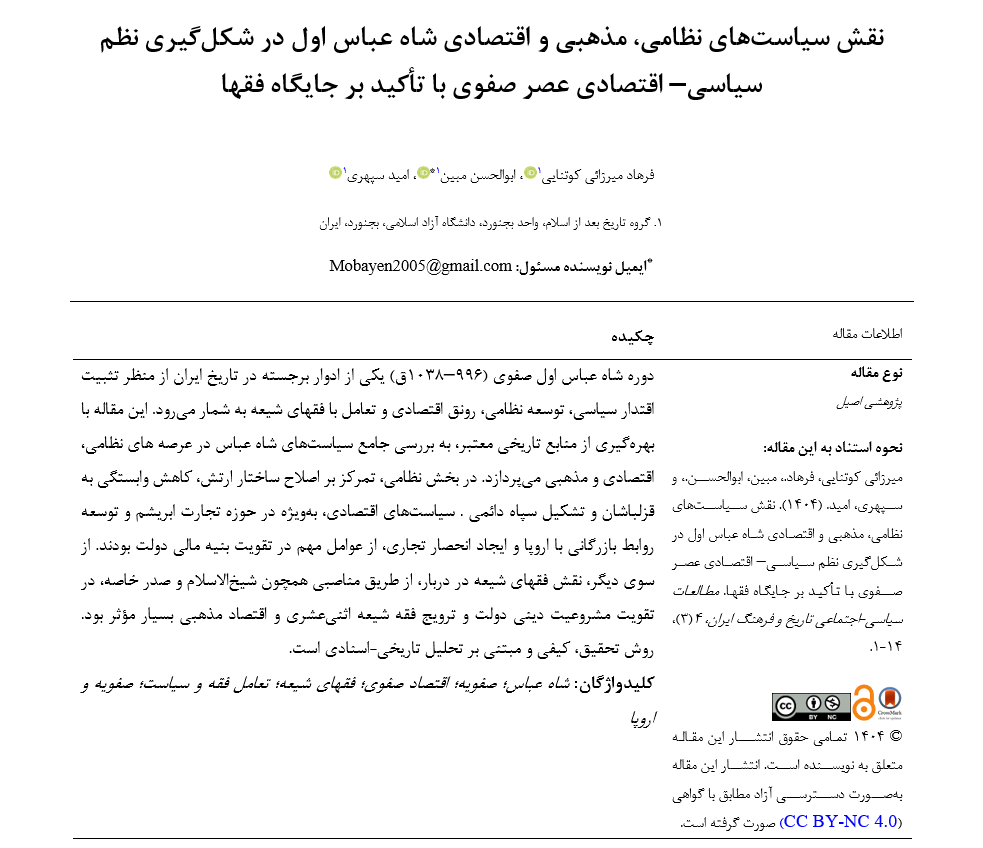
نقش سیاستهای نظامی، مذهبی و اقتصادی شاه عباس اول در شکلگیری نظم سیاسی– اقتصادی عصر صفوی با تأکید بر جایگاه فقها
کلمات کلیدی:
شاه عباس, صفویه, اقتصاد صفوی, فقهای شیعه, تعامل فقه و سیاست, صفویه و اروپاچکیده
دوره شاه عباس اول صفوی (۹۹۶–۱۰۳۸ق) یکی از ادوار برجسته در تاریخ ایران از منظر تثبیت اقتدار سیاسی، توسعه نظامی، رونق اقتصادی و تعامل با فقهای شیعه به شمار میرود. این مقاله با بهرهگیری از منابع تاریخی معتبر، به بررسی جامع سیاستهای شاه عباس در عرصه های نظامی، اقتصادی و مذهبی میپردازد. در بخش نظامی، تمرکز بر اصلاح ساختار ارتش، کاهش وابستگی به قزلباشان و تشکیل سپاه دائمی . سیاستهای اقتصادی، بهویژه در حوزه تجارت ابریشم و توسعه روابط بازرگانی با اروپا و ایجاد انحصار تجاری، از عوامل مهم در تقویت بنیه مالی دولت بودند. از سوی دیگر، نقش فقهای شیعه در دربار، از طریق مناصبی همچون شیخالاسلام و صدر خاصه، در تقویت مشروعیت دینی دولت و ترویج فقه شیعه اثنیعشری و اقتصاد مذهبی بسیار مؤثر بود. روش تحقیق، کیفی و مبتنی بر تحلیل تاریخی-اسنادی است.
دانلودها
مراجع
Afandi Isfahani, M. A. (2010). Riyad al-'Ulama' wa Hiyad al-Fudala' (Vol. 3). Najafi Islamic Research Foundation.
Afshar, I. (2008). Iranian Culture (Vol. 14). Sokhan Publications.
Bastani Parizi, M. E. (1999). Politics and Economy of the Safavid Era. Safi Alishah.
Bondarevsky, G. (1982). The Aspirants and the Imperialists in the Persian Gulf. Aboureihan.
Chalabi, E. (1959). Siyahatnameh.
Chardin, J. (2001). Travelogue.
Cohen, J. S. (1973). Economics, Politics, and History: Latin American Essays. MIT Press.
della Valle, P. (2001). Travelogue (Vol. 1). Qatreh Publications.
Falsafi, N. (1963). Iran's Foreign Policy in the Safavid Period. Pocket Books Organization.
Falsafi, N. (1992). The Life of Shah Abbas I (Vol. 3). Ilmi Publications.
Floor, W. (1977). The First Iranian and Dutch Ambassadors. Tahouri.
Floor, W. (2000). The Persian Gulf: The Rise of the Gulf Arabs. Mage Publishers.
Foran, J. (1994). Fragile Resistance: Social Transformation in Iran from 1500 to the Revolution. Westview Press.
Lambton, A. K. S. (1980). State and Government in Medieval Islam. Oxford University Press.
Matthee, R. (1999). The Politics of Trade in Safavid Iran: Silk for Silver, 1600-1730. Cambridge University Press.
Modarresi Tabatabaei, S. J. f. (1995). The School in the Process of Evolution. Sama Cultural Institute.
Monajjem, M. J. a.-D. (1987). Tarikh-e Abbasi or Rooznameh-ye Molla Jalal. Vahid.
Motahari, M. (2000). Velayat-e Faqih (Guardianship of the Islamic Jurist). Sadra.
Olearius, A. (1984). Travelogue. Ebtekar.
Qomi, M. T. i. M. H. (1998). Mounes al-Abrar: In Refutation of the Sufis The Islamic Heritage of Iran (Vol. 7). Ayatollah al-Uzma Marashi Najafi Library.
Qomi, Q. A. i. S. a.-D. a.-H. a.-H. (2004). Khulasat al-Tavarikh (Vol. 2). Tehran University.
Rahimzadeh, S. (1962). The Life of Shah Ismail. Khayyam Publications.
Roemer, H. R. (2006). Iran on the Way to a New Era. Tehran University.
Safa, Z. (1989). The Socio-Political-Cultural History of Iran. Amir Kabir.
Savory, R. M. (2006). Iran in the Safavid Age. Nashr-e Markaz.
Scott, J. C. (1998). Seeing Like a State: How Certain Schemes to Improve the Human Condition Have Failed. Yale University Press.
Shishehchi, H. (2005). The Role of the Persian Gulf Ports in Safavid Trade. Persian Gulf Studies, 1(6), 90-108.
Tajbakhsh, A. (1993). History of the Safavids. Navid Publications.
Taremi, H. (1996). Allameh Majlesi. Negah-e Now.
Tavernier, J.-B. (1990). Travelogue (Vol. 4). Sanai.
Tilly, C. (1990). Coercion, Capital, and European States, AD 990-1990. Basil Blackwell.
Torkaman, E. B. (1971). Alam Ara-ye Abbasi (Vol. 2). Golshan Publications.
Weber, M. (1978). Economy and Society: An Outline of Interpretive Sociology. University of California Press.
Weber, M. (2005). Economy and Society. Akhtaran Publications.
Zarrinkoub, A. (2006). In Search of Sufism in Iran. Amir Kabir.
دانلود
گاهشمار انتشار
- ارسال
- بازنگری
- پذیرش
شماره
نوع مقاله
مجوز
حق نشر 2025 Farhad Mirzaeiikoutenaei (Author); Abolhassan Mobyeen (Corresponding Author); Omid Sepehri (Author)

این پروژه تحت مجوز بین المللی Creative Commons Attribution-NonCommercial 4.0 می باشد.