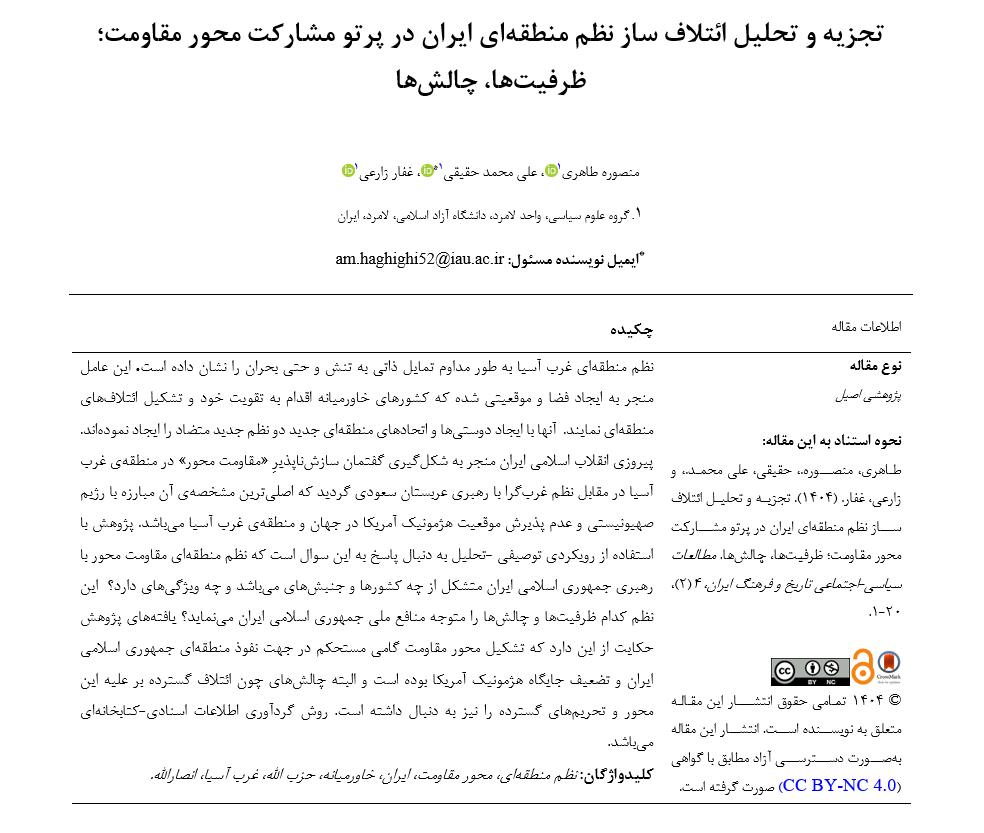
Analysis of Iran’s Regional Order-Building Coalition in Light of Participation in the Resistance Axis: Capacities and Challenges
DOI:
https://doi.org/10.61838/kman.jspsich.535Keywords:
Regional order, Axis of Resistance, Iran, Middle East, Hezbollah, West Asia, Ansar AllahAbstract
The regional order of West Asia has continuously demonstrated an inherent tendency toward tension and even crisis. This factor has created a space and situation in which Middle Eastern countries have sought to strengthen themselves and form regional coalitions. By establishing new regional friendships and alliances, they have created two new opposing orders. The victory of the Islamic Revolution of Iran led to the formation of the uncompromising “Resistance Axis” discourse in the West Asian region against the Western-oriented order led by Saudi Arabia, whose main characteristic is the struggle against the Zionist regime and the rejection of the hegemonic position of the United States in the world and in the West Asian region. Using a descriptive-analytical approach, this study seeks to answer the question of which countries and movements constitute the resistance-oriented regional order led by the Islamic Republic of Iran and what characteristics it possesses. It also examines which capacities and challenges this order creates for the national interests of the Islamic Republic of Iran. The findings of the study indicate that the formation of the Resistance Axis has been a firm step toward expanding the regional influence of the Islamic Republic of Iran and weakening the hegemonic position of the United States, although it has also entailed challenges such as the formation of a broad coalition against this axis and extensive sanctions. The data collection method is documentary and library-based.
Downloads
References
Abbasi, M., & Mohammadi, V. (2013). A Realist Explanation of the International Power Conflict in Syria and Its Consequences for the Security of the Islamic Republic of Iran. Iranian Research Letter of International Politics, 2(1), 70-93.
Amble, D. S. (2022). Theorizing the Emergence of Security Regions: An Adaptation for the Regional Security Complex Theory. Global Studies Quarterly, 2(4), 1-10.
Ataie, M. (2021). Continuity despite Revolution: Iran's Support for Non-State Actors. Middle East Briefs, 139(2), 123-143.
Azizi, H., Golmohammadi, V., & Vazirian, A. H. (2020). Trump's Maximum Pressure and Anti-Containment in Iran's Regional Policy. Digest of Middle East Studies, 29(2), 150-165.
Barzegar, K. (2017). Foreign Policy of the Islamic Republic of Iran in the Middle East. Qoqnoos Publishing.
Blanford, N. (2017). Hezbollah's Evolution: From Lebanese Militia to Regional Player. PP4_Blanford_Hezbollah.pdf (mei.edu)
Buzan, B. (1983). People, States and Fear: An Agenda for International Security Studies in the Post-Cold War Era. Review of International Studies, 24(2), 133-134.
Buzan, B. (2016). People, States and Fear: An Agenda for International Security Studies in the Post-Cold War Era. ECPR Press.
Buzan, B., & Waever, O. (2003). Regions and Powers. Cambridge University Press.
Cruden, M. (2011). Regional Security Complex Theory: Southeast Asia and the South Pacific The University of Waikato].
Deepak, N. (2009). Regionalism in the Asia Pacific/East Asia: A Frustrated Regionalism. Contemporary Southeast Asia, 31(1), 112-132.
Golshani, A., & Bagheri, M. (2012). The Position of Lebanese Hezbollah in the Deterrence Strategy of the Islamic Republic of Iran. Quarterly Journal of Political and International Research, 11(2), 123-156.
Goodarzi, J. (2013). Syria and Iran: Alliance Cooperation in a Changing Regional Environment. Ortadogu Etutleri, 4(2), 31-54.
Heras, N. A. (2017). Iraq's Fifth Column: Iran's Proxy Network (MEI Policy Paper, Issue.
Huntington, S. (1999). The Lonely Superpower. Foreign Affairs, 78(2), 35-49.
Hurrell, A. (2006). Hegemony, Liberalism, and Global Order: What Space for Would-Be Great Powers? International Affairs, 82(1), 1-19.
Jones, P. (2022). A Middle East Cooperation and Security Process: Has the Time Come? Middle East Policy, 29(1), 74-89.
Katz, B. (2018). Axis Rising: Iran's Evolving Regional Strategy and Non-State Partnerships in the Middle East. International Security, 12(3), 23-39.
Katzenstein, P. (2015). A World of Regions: Asia and Europe in the American Imperium. Cornell University Press.
Kelly, R. E. (2007). Security Theory in the New Regionalism. International Studies Review, 9(2), 197-229.
Khan, A., & Zhaoying, H. (2020). Iran-Hezbollah Alliance Reconsidered: What Contributes to the Survival of State-Proxy Alliance? Journal of Asian Security and International Affairs, 7(1), 101-123.
Koch, B., & Stivachtis, Y. (2019). Regional Security in the Middle East. E-International Relations.
Kose, T., Ozcan, M., & Karakoc, E. (2016). A Comparative Analysis of Soft Power in the MENA Region: The Impact of Ethnic, Sectarian, and Religious Identity on Soft Power in Iraq and Egypt. Foreign Policy Analysis, 12(3), 354-373.
Lobel, O. (2021). Becoming Ansar Allah: How the Islamic Revolution Conquered Yemen. Houthi-Iran-Report-Oved-Lobel-Final-Version.pdf (eeradicalization.com)
Martin, S. (2018). The New American Strategy on Iran. On War | On Peace
Moradi, A. (2015). The Syrian Crisis and the Regional Security of the Islamic Republic of Iran. Quarterly Journal of Strategic Policy Research, 4(15), 58-76.
Nezam, A. H. (2016). Light and Shadow of Hashd al-Shaabi. Andisheh-Sazan Noor Studies Institute.
Osterud, O. (1992). Regional Great Powers. In I. B. Neumann (Ed.), Regional Great Powers in International Politics (pp. 1-15). Springer Publishing.
Pollack, K. M. (2020). The Evolution of the Revolution. The-Evolution-of-the-Revolution.pdf (aei.org)
Riedel, B. (2017). Who Are the Houthis, and Why Are We at War with Them? https://www.brookings.edu/blog/markaz/2017/12/18/who-are-the-houthis-and-why-are-we-at-war-with-the
Risseeuw, R. (2018). The Syrian-Iranian Nexus: A Historical Overview of Strategic Cooperation. The-Syria-Iran-Nexus-1.pdf (bic-rhr.com)
Rolf, M. (2015). The Iran Deal and a New US Strategy for the Middle East. https://www.justsecurity.org/24948/iran-deal-strategy-middle-east
Rolfe, J. (2008). Regional Security for the Asia-Pacific: Ends and Means. Contemporary Southeast Asia: A Journal of International and Strategic Affairs, 30(8), 99-117.
Shiroudi, M., & Shah Ali, A. (2019). The Encounter between the Discourse of Resistance (Shiite) and the Salafi-Ikhwani Discourse on the Traditional Security Arrangements of West Asia. Quarterly Journal of International Relations Studies, 12(48), 43-63.
Smith, N. R. (2020). When Hedging Goes Wrong: Lessons from Ukraine's Failed Hedge of the EU and Russia. Global Policy, 11(5), 588-597.
Soltaninejad, M. (2019). Coalition-Building in Iran's Foreign Policy: Understanding the Axis of Resistance. Journal of Balkan and Near Eastern Studies, 21(6), 717-731.
Steinberg, G. (2021). The Axis of Resistance (International and Security Affairs, Issue.
Stewart-Ingersoll, R., & Frazier, D. (2012). Regional Powers and Security Orders: A Theoretical Framework. Routledge.
Taha, L. W. (2022). The Iranian Involvement in the Yemeni War Lebanese American University].
Tank, P. (2013). The Concept of Rising Powers. https://www.files.ethz.ch/isn/146521/aa7c23bf5887ab060f1af737a39a000a.pdf
Uzun, E. (2018). The Axis of Resistance: The Role of Religion in Iranian Foreign Policy Sabanci University].
Walsh, B. (2021). Revisiting Regional Security Complex Theory in Africa: Museveni's Uganda and Regional Security in East Africa. African Security, 13(4), 300-324.
Wastnidge, E. (2017). Iran and Syria: An Enduring Axis. Middle East Policy, 11(2), 148-159.
Winter, L. (2010). Fragile State: Yemen in Conflict. Current History, 109(12), 395-400.
Zimmerman, K. (2022). Yemen's Houthis and the Expansion of Iran's Axis of Resistance. Yemen's-Houthis-and-the-expansion-of-Iran's-Axis-of-Resistance.pdf (aei.org)
Downloads
Publication Timeline
- Submitted
- Revised
- Accepted
Issue
Section
License
Copyright (c) 2025 Mansoreh Taheri (Author); Ali Mohammad Haghighi (Corresponding Author); Ghaffar Zarei (Author)

This work is licensed under a Creative Commons Attribution-NonCommercial 4.0 International License.