The Emergence and Expansion of the Kharijites in Sistan and Kerman Based on the Center–Periphery Theory: A Historical–Sociological Analysis with Emphasis on Ethnic and Geographical Characteristics
DOI:
https://doi.org/10.61838/kman.jspsich.481Keywords:
Khawarij, focus and periphery, Sistan, Kerman, Marginal Movement, Alternative authorityAbstract
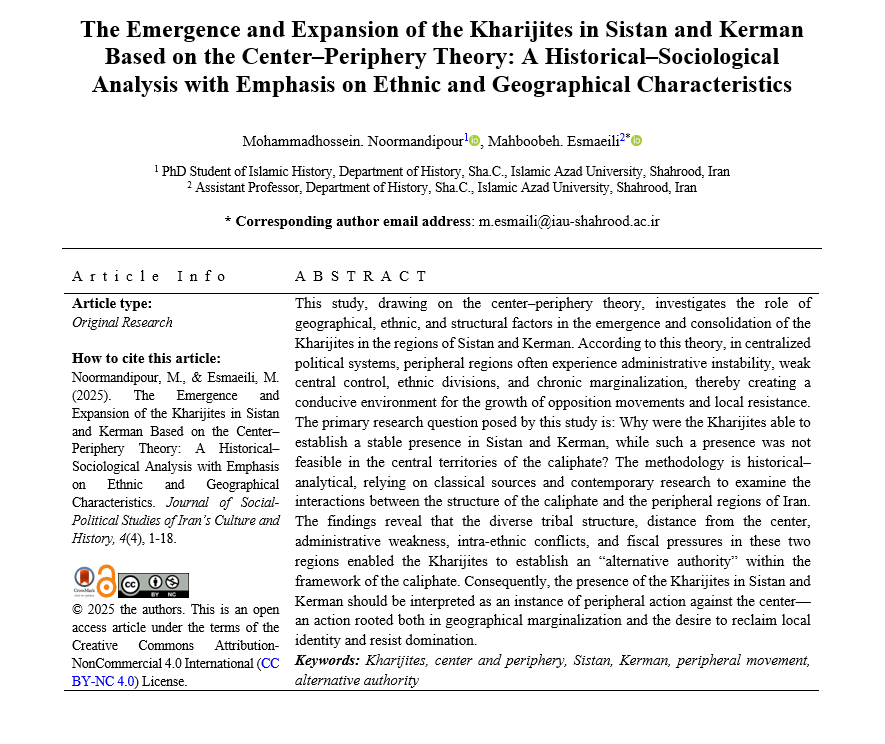
This study, drawing on the center–periphery theory, investigates the role of geographical, ethnic, and structural factors in the emergence and consolidation of the Kharijites in the regions of Sistan and Kerman. According to this theory, in centralized political systems, peripheral regions often experience administrative instability, weak central control, ethnic divisions, and chronic marginalization, thereby creating a conducive environment for the growth of opposition movements and local resistance. The primary research question posed by this study is: Why were the Kharijites able to establish a stable presence in Sistan and Kerman, while such a presence was not feasible in the central territories of the caliphate? The methodology is historical–analytical, relying on classical sources and contemporary research to examine the interactions between the structure of the caliphate and the peripheral regions of Iran. The findings reveal that the diverse tribal structure, distance from the center, administrative weakness, intra-ethnic conflicts, and fiscal pressures in these two regions enabled the Kharijites to establish an “alternative authority” within the framework of the caliphate. Consequently, the presence of the Kharijites in Sistan and Kerman should be interpreted as an instance of peripheral action against the center—an action rooted both in geographical marginalization and the desire to reclaim local identity and resist domination.
Downloads
References
Berkey, J. (2003). The Formation of Islam: Religion and Society in the Near East, 600–1800. Cambridge University Press. https://doi.org/10.1017/CBO9780511817861
Binaaz, A. A. (2013). Historical Geography of Southeastern Iran. Research Institute of Cultural Heritage.
Blachère, R. (1994). The Problem of the Kharijites. In P. M. Holt (Ed.), The Islamic World (pp. 87). Cambridge University Press.
Bosworth, C. E. (1968). Sīstān under the Arabs. Islamic Quarterly, 12(3), 129-148.
Bosworth, C. E. (1994). The History of the Saffarids of Sistan and the Maliks of Nimruz (861–1542). Columbia University Press.
Christensen, A. (2004). Iran in the Sassanid Era. Amir Kabir.
Crone, P. (1980). Slaves on Horses: The Evolution of the Islamic Polity. Cambridge University Press.
Crone, P. (2003). Medieval Islamic Political Thought. Edinburgh University Press. https://doi.org/10.1515/9780748646500
Dodge, T. (2002). Inventing Iraq: The Failure of Nation Building and a History Denied. Columbia University Press.
Donner, F. M. (1981). The Early Islamic Conquests. Princeton University Press.
Hagemann, H., Tamm, D., & Mahfouz, F. (2020). The Kharijites and Their Legacy in the Islamic World: A Historical and Statistical Analysis. Journal of Islamic Studies, 31(3), 479-505. https://doi.org/10.1093/jis/etaa017
Hawting, G. R. (2000). The First Dynasty of Islam: The Umayyad Caliphate AD 661–750. Routledge.
Herzog, T. (2011). Frontiers of Possession: Spain and Portugal in Europe and the Americas. Harvard University Press.
Kennedy, H. (2004). The Prophet and the Age of the Caliphates. Pearson Education.
Kenney, J. P. (1991). Muslim Rebels: Kharijites and the Politics of Extremism in Early Islam. Oxford University Press.
Lambton, A. K. S. (1988). Continuity and Change in Medieval Persia. State University of New York Press.
Madelung, W. (1997). The Succession to Muhammad: A Study of the Early Caliphate. Cambridge University Press. https://doi.org/10.1017/CBO9780511582042
McNeill, W. H. (1982). The Pursuit of Power: Technology, Armed Force, and Society since A.D. 1000. University of Chicago Press. https://doi.org/10.7208/chicago/9780226160191.001.0001
Sajistani, A. Y. (1993). Maqālāt al-Islāmiyyīn. Elmi va Farhangi Publications.
Scott, J. C. (2009). The Art of Not Being Governed: An Anarchist History of Upland Southeast Asia. Yale University Press.
Shils, E. (1975). Center and Periphery: Essays in Macrosociology. University of Chicago Press.
Ṭabarī, M. b. J. (2008). Tārīkh al-Ṭabarī (Vol. 5–9). Asatir.
Tilly, C. (1990). Coercion, Capital, and European States, AD 990–1992. Blackwell.
Wallerstein, I. (1974). The Modern World-System I: Capitalist Agriculture and the Origins of the European World-Economy in the Sixteenth Century. Academic Press.
Wallerstein, I. (1980). The Modern World-System II: Mercantilism and the Consolidation of the European World-Economy, 1600–1750. Academic Press.
Watt, W. M. (1962). Islamic Political Thought. Edinburgh University Press.
Ya‘qūbī, A. b. A. Y. q. (2014). The History of Ya‘qūbī (Vol. 2). Sadough Publishing.
Yāqūt al-Ḥamawī. (1997). Mu‘jam al-Buldān (Vol. 3). Amir Kabir Publications.
Zarrinkoub, A. (2005). Rūzegārān: A History of Iran from the Beginning to the Fall of the Pahlavi Monarchy. Sokhan.
Downloads
Publication Timeline
- Submitted
- Revised
- Accepted
Issue
Section
License
Copyright (c) 2025 محمدحسین نورمندی پور (نویسنده); محبوبه اسماعیلی

This work is licensed under a Creative Commons Attribution-NonCommercial 4.0 International License.