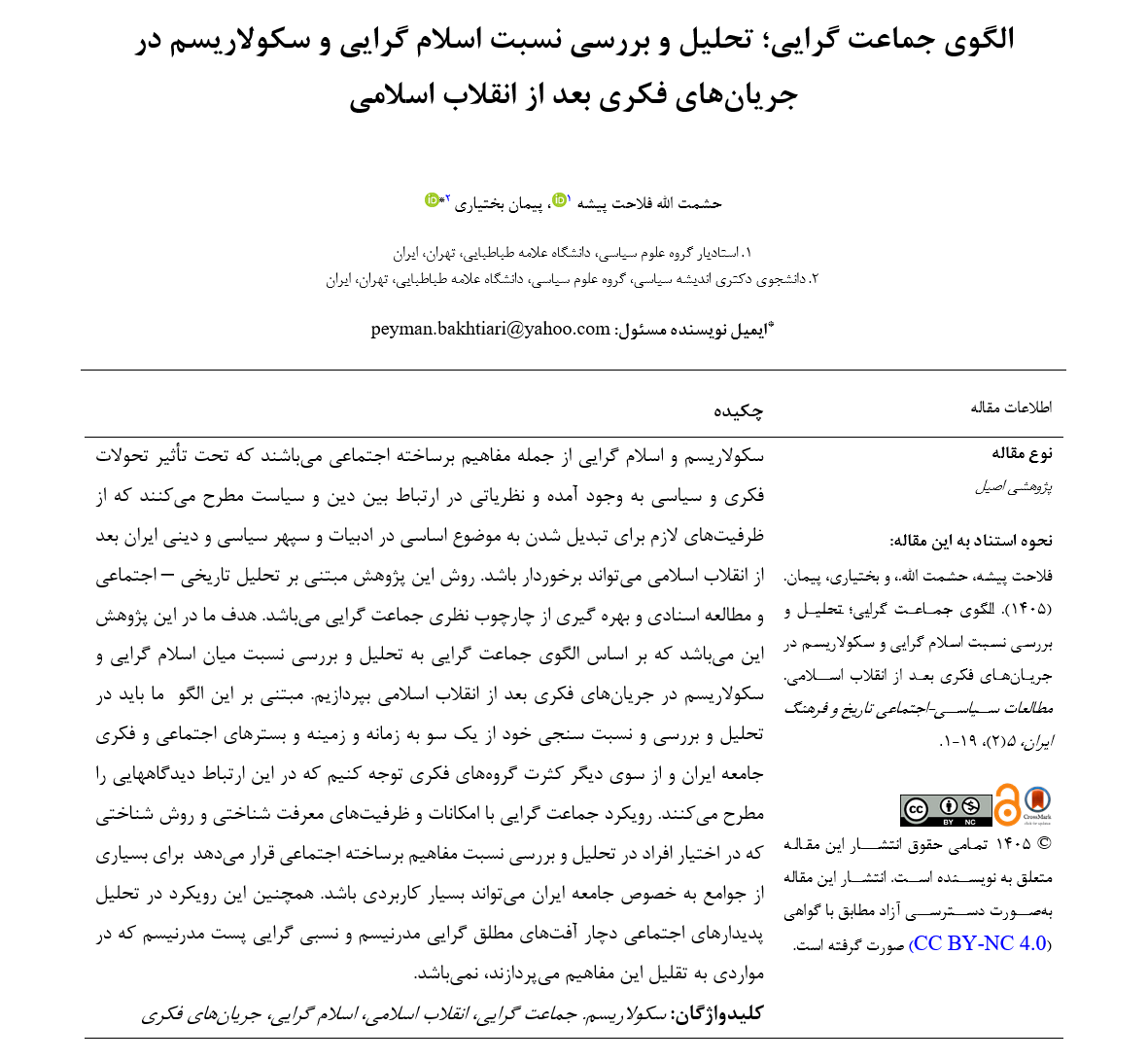
The Communitarianism Model: An Analysis and Examination of the Relationship Between Islamism and Secularism in Intellectual Currents After the Islamic Revolution
Keywords:
Secularism, Communitarianism, Islamic Revolution, Islamism, Intellectual CurrentsAbstract
Secularism and Islamism are among the socially constructed concepts that emerged under the influence of intellectual and political transformations and present theories concerning the relationship between religion and politics. These concepts possess the necessary capacities to become fundamental subjects within the political and religious literature and sphere of post–Islamic Revolution Iran. The method of this study is based on historical–social analysis, documentary research, and the application of the theoretical framework of communitarianism. The purpose of this research is to analyze and examine the relationship between Islamism and secularism in intellectual currents after the Islamic Revolution based on the communitarianism model. According to this model, in conducting our analysis, examination, and relational assessment, we must pay attention, on the one hand, to the historical context, circumstances, and social and intellectual foundations of Iranian society, and, on the other hand, to the plurality of intellectual groups that present viewpoints in this regard. The communitarian approach, through the epistemological and methodological capacities it provides for the analysis and examination of socially constructed concepts, can be highly applicable to many societies, particularly Iranian society. Furthermore, this approach avoids the pitfalls of the absolutism of modernism and the relativism of postmodernism, both of which, in certain cases, reduce the complexity of these concepts.
Downloads
References
Abrahamian, E. (2010). Iran between Two Revolutions. Ney.
Ahmadi, H. (2016). Sociology of Islamic Movements. Imam Sadiq Publications.
Al Seyed Ghafour, M. (2009). The Communitarian Model and the Plurality of Intellectual-Political Traditions in Contemporary Iran. Politics Quarterly, 39(2).
Ashouri, D. (2016). We and Modernity: A Conversation with Dariush Ashouri. Tavana.
Azad Armaki, T. (2001). Iranian Modernity, Intellectualism, and the Intellectual Paradigm of Backwardness in Iran. Ejtemaa.
Azghandi, A. R. (2012). An Introduction to the Political Sociology of Iran. Qoms.
Barbier, M. (2004). Political Modernity. Agah.
Bashiriyeh, H. (2002). A Preface to the Political Sociology of Iran. Negah-e Moaser.
Bashiriyeh, H. (2015). Reason in Politics: Thirty-Five Essays in Philosophy, Sociology, and Political Development (5 ed.). Negah-e Moaser.
Dabbagh, S. (2010). Religious Intellectuals and Ethics. Serat.
Dabbagh, S. (2011). The Rhythmic Song of Sorrow. Kavir.
Dabbagh, S. (2017). The Sound of the Mirror's Journey. Sohravardi Foundation.
Doustdar, A. (1991). Dark Radiances. Andisheh-ye Azad.
Ebrahimi, Z. (2024). Is Secularization Possible in Islam? An Explanation and Critique of the Emergence of Political Islam Concepts in Contemporary Iran. https://www.3danet.ir
Haghighat, S. S. (2020). Communitarianism between Text and Context. Human Rights Quarterly(30), 5-18.
Hosseinizadeh, S. M. A. (2006). Political Islam in Iran. Mofid University.
Hunter, S. (2001). The Future of Islam and the West: Clash of Civilizations or Peaceful Coexistence. Farzan.
Jahanbegloo, R. (2002). The Fourth Wave. Ney.
Jalili, H. (2004). Sociological Reflections on Secularization. Tarh-e No.
Khosrokhavar, F., & Mottaghi, M. (2015). Secular Intellectuals in Contemporary Iran. Azadi-ye Andisheh(2), 107-128.
Malekian, M. (2018). The Scholarly Position of Dariush Shayegan. https://www.3danet.ir
Mohaddesi, H. (2013). The Failure of the Secularist Project of Society: The Ground for the Emergence of Religious Intellectualism. Nasim-e Bidari(33-34).
Naraghi, A. (2016). Tradition and Open Horizons. Negah-e Moaser.
Nejati Hosseini, S. M. (2023). There Is No Such Thing as Secularism in Iran. Asr-e Andisheh Monthly, 8(31).
Nouri, M. (2024). Dariush Ashouri's Narrative of the Question of Development in Iran. Ketab-e Sharq.
Nouri, M., & Abbasabadi, H. (2021). Critique and Review of the Book A Critical View of Communitarian Development. Critical Research Journal of Humanities Texts and Programs, 21(6), 455-476.
Qazalsafli, M. T., & Maash Sani, S. (2010). Cultural Iran in the Thought of Dariush Shayegan. Political Science Research Quarterly, 5(4), 137-171.
Shahbazi, A. (2010). Modernity, Development, and Today's World. https://www.shahbaz.org
Shayegan, D. (2017). The New Enchantment: Patchwork Identity and Mobile Thought. Farzan.
Tabari, E. (2013). On Religion and a Methodological Critique of Doustdar's Concept of Religion-Mindedness. Kharmagas Philosophical-Social Journal(1).
Taylor, C. (2019). Earthly Life and Heavenly Mystery. Negah-e Moaser.
Vahdat, F. (2003). Iran's Intellectual Encounter with Modernity. Qoqnoos.
Downloads
Publication Timeline
- Submitted
- Revised
- Accepted
Issue
Section
License
Copyright (c) 2025 Peyman Bakhtiari; Heshmatollah Falahatpisheh (Author)

This work is licensed under a Creative Commons Attribution-NonCommercial 4.0 International License.