The Gender Order in Post-Revolutionary Iran: The Religion–State Nexus, Institutional Transformations, and Women’s Agency (1979–2023)
Keywords:
Gender system, patriarchy, religion, politics, society, Iran after the revolutionAbstract
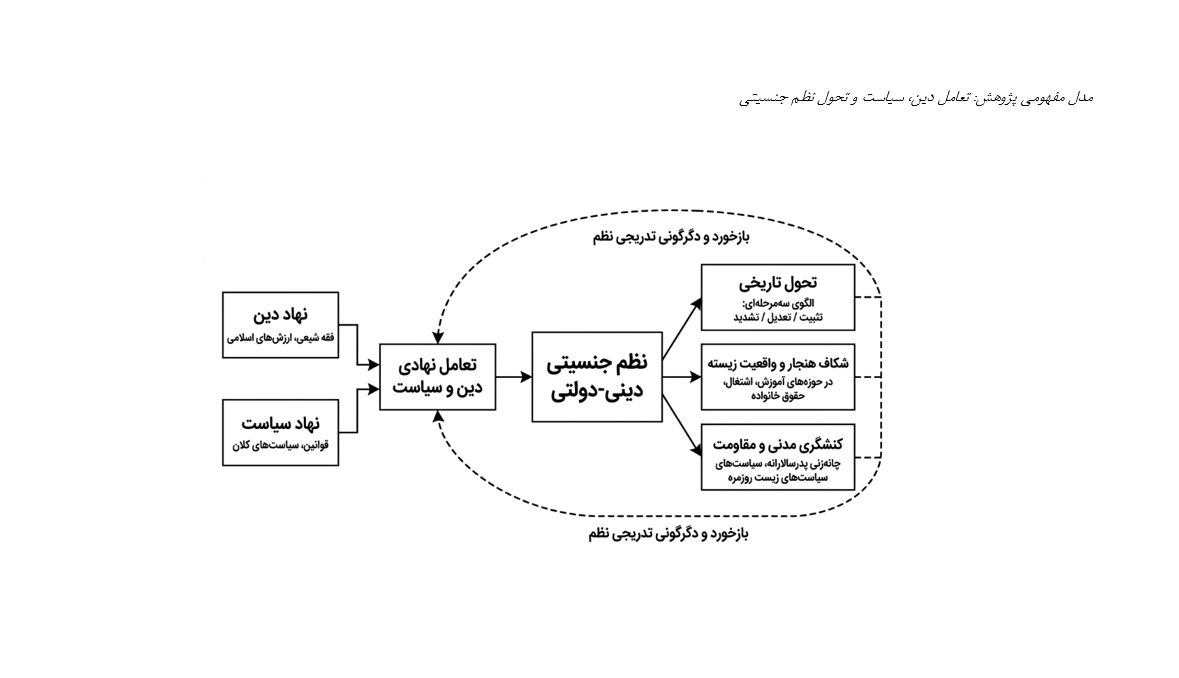
Using a qualitative sociological approach that combines thematic analysis with historical-institutional analysis, this article examines the transformation of the gender order in Iran following the Islamic Revolution (1979–2023) and its social consequences for women. The central research question concerns the interactive role of religious and political institutions in shaping women’s legal and social status. Data were collected from two sources: (a) semi-structured interviews with 22 women occupying different subject positions, including nine institutional administrators and 13 civil society and independent activists, selected through purposive sampling using a limited-variation approach among urban, educated women; and (b) a review and analysis of 45 high-level policy documents, including legislation, general family policies, population policies, and five-year development plans, of which 10 key documents were subjected to in-depth analysis. The findings indicate that Iran’s gender order has undergone three stages: “institutional consolidation” (1979–1989), “relative moderation” (1989–2005), and “intensified conservatism” (2005–2023). These stages are documented with reference to major political developments, including the end of the Iran–Iraq War, changes in government administrations, and the implementation of national development plans. The principal consequence has been the emergence of a profound gap between the “normative order” and women’s “lived realities” in higher education, employment, family law, and political participation. For example, although women constitute more than 60% of university students (Statistical Center of Iran, 2021), their economic participation rate has remained at approximately 16% (World Bank, 2022). In response to these structural constraints, Iranian women have developed diverse strategies of civic activism, ranging from organized legal campaigns to informal forms of action within the framework of the “politics of everyday life.” The article concludes that an accurate understanding of Iran’s gender order requires an integrated interpretation of the interactions among religion, politics, and social agency.
Downloads
References
Afary, J. (2009). Sexual Politics in Modern Iran. Cambridge University Press.
Al-Rasheed, M. (2013). A Most Masculine State: Gender, Politics, and Religion in Saudi Arabia. Cambridge University Press.
Bayat, A. (2010). Life as Politics: How Ordinary People Change the Middle East. Stanford University Press.
Braun, V., & Clarke, V. (2021). Thematic Analysis: A Practical Guide. Sage Publications.
British Educational Research, A. (2018). Ethical Guidelines for Educational Research.
Creswell, J. W., & Poth, C. N. (2018). Qualitative Inquiry and Research Design: Choosing among Five Approaches (4th ed.). Sage Publications.
Denzin, N. K. (1978). The Research Act: A Theoretical Introduction to Sociological Methods (2nd ed.). McGraw-Hill.
Gole, N. (1996). The Forbidden Modern: Civilization and Veiling. University of Michigan Press.
Hoodfar, H., & Assadpour, S. (2000). The Politics of Population Policy in the Islamic Republic of Iran. Studies in Family Planning, 31(1), 19-34.
Kandiyoti, D. (1988). Bargaining with Patriarchy. Gender & Society, 2(3), 274-290.
Kandiyoti, D. (1991). Islam and Patriarchy: A Comparative Perspective. In N. R. Keddie & B. Baron (Eds.), Women in Middle Eastern History (pp. 23-42). Yale University Press.
Kian-Thiebaut, A. (2005). Changes in the Legal Status of Women and the Family in Iran since 1979. Critique Internationale, 28(3), 91-108.
Kian, A. (1997). Women and Politics in Post-Islamist Iran: The Gender Conscious Drive to Change. British Journal of Middle Eastern Studies, 24(1), 75-96.
Kvale, S., & Brinkmann, S. (2009). InterViews: Learning the Craft of Qualitative Research Interviewing (2nd ed.). Sage Publications.
Lincoln, Y. S., & Guba, E. G. (1985). Naturalistic Inquiry. Sage Publications.
Mahmood, S. (2005). Politics of Piety: The Islamic Revival and the Feminist Subject. Princeton University Press.
Merriam, S. B., & Tisdell, E. J. (2016). Qualitative Research: A Guide to Design and Implementation (4th ed.). Jossey-Bass.
Mir-Hosseini, Z. (1996). Women and Politics in Post-Khomeini Iran: Divorce, Veiling and Emerging Feminist Voices. In H. Afshar (Ed.), Women and Politics in the Third World (pp. 142-162). Routledge.
Moghadam, V. M. (2003). Modernizing Women: Gender and Social Change in the Middle East (2nd ed.). Lynne Rienner Publishers.
Nosrat Khwarazmi, Z., Ghasempour, F., & Nosrat Khwarazmi, H. (2020). Women's Cultural Agency after the Islamic Revolution: A Discourse Analysis of Islamic Feminism's Demands in the Islamic Republic of Iran. Social Studies and Research in Iran, 9(4), 931-966.
Osanloo, A. (2009). The Politics of Women's Rights in Iran. Princeton University Press.
Paidar, P. (1995). Women and the Political Process in Twentieth-Century Iran. Cambridge University Press.
Patton, M. Q. (2015). Qualitative Research and Evaluation Methods (4th ed.). Sage Publications.
Sanasarian, E. (1982). The Women's Rights Movement in Iran: Mutiny, Appeasement, and Repression from 1900 to Khomeini. Praeger.
Scott, J. W. (1986). Gender: A Useful Category of Historical Analysis. The American Historical Review, 91(5), 1053-1075.
Scott, J. W. (1995). Gender and the Politics of History (Rev. ed.). Columbia University Press.
Tohidi, N. (2016). Women's Rights and Feminist Movements in Iran. Sur - International Journal on Human Rights, 13(24), 75-89.
Walby, S. (1990). Theorizing Patriarchy. Blackwell.
Zia, A. S. (2009). Faith-Based Politics, Enlightened Moderation and the Pakistani Women's Movement. Journal of International Women's Studies, 11(1), 225-245.
Downloads
Publication Timeline
- Submitted
- Revised
- Accepted
Issue
Section
License
Copyright (c) 2025 elham Afshar Kohan (Author); Abolfazl Zolfaghari (Corresponding Author); Abbas Keshavarz Shokri (Author)

This work is licensed under a Creative Commons Attribution-NonCommercial 4.0 International License.