Religious and Political Perspectives in Sasanian Iran
Keywords:
Sasanians, Zoroastrianism, Farah Yazdi, Political Legitimacy, Zoroastrian Clergy, Religion and StateAbstract
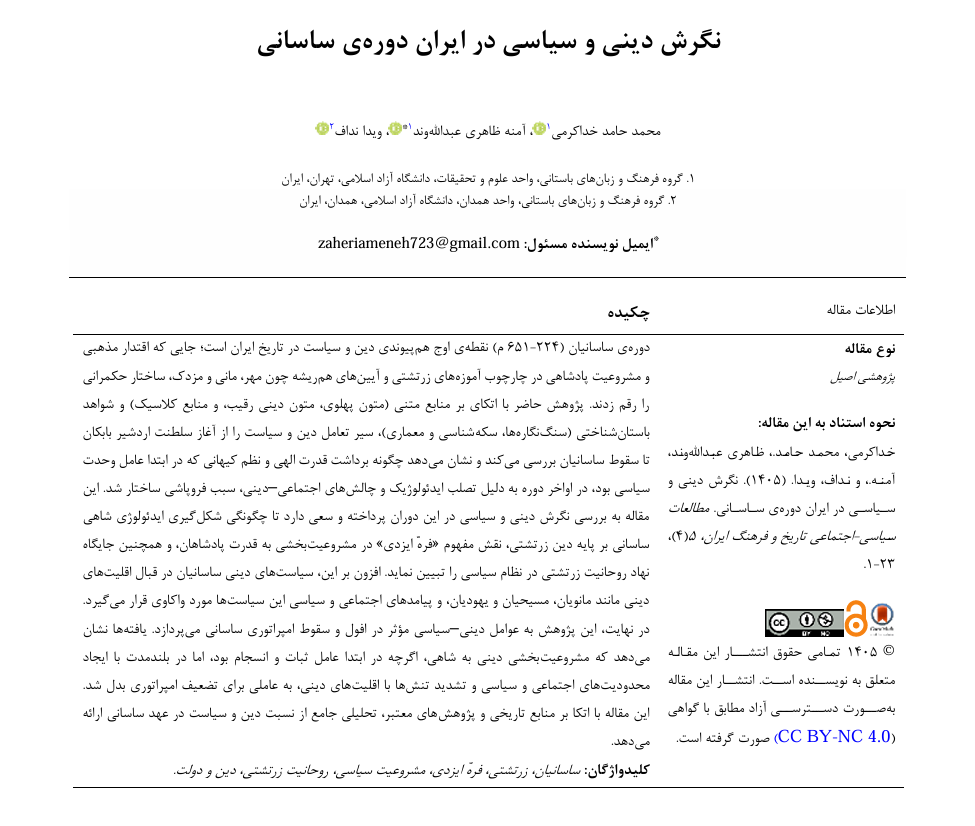
The Sasanian period (224–651 CE) represents the culmination of the interconnection between religion and politics in Iranian history, a period in which religious authority and royal legitimacy shaped the structure of governance within the framework of Zoroastrian teachings and related religious traditions such as Mithraism, Manichaeism, and Mazdakism. Drawing on textual sources (Pahlavi texts, rival religious writings, and classical sources) and archaeological evidence (rock reliefs, numismatics, and architecture), the present study examines the development of the interaction between religion and politics from the beginning of the reign of Ardashir I to the fall of the Sasanian Empire. It demonstrates how conceptions of divine authority and cosmic order, which initially functioned as sources of political unity, contributed in the late Sasanian period to the disintegration of the political structure due to ideological rigidity and socio-religious challenges. This article examines religious and political perspectives during this period and seeks to explain the formation of Sasanian royal ideology on the basis of Zoroastrianism, the role of the concept of “divine glory” (xwarrah) in legitimizing royal authority, and the position of the Zoroastrian priesthood within the political system. In addition, the religious policies of the Sasanians toward religious minorities, including Manichaeans, Christians, and Jews, and the social and political consequences of these policies are analyzed. Finally, the study addresses the religious and political factors that contributed to the decline and fall of the Sasanian Empire. The findings indicate that although the religious legitimation of kingship initially served as a source of stability and cohesion, in the long term it became a factor contributing to the weakening of the empire by imposing social and political constraints and intensifying tensions with religious minorities. Drawing on historical sources and authoritative scholarship, this article provides a comprehensive analysis of the relationship between religion and politics during the Sasanian period.
Downloads
References
Boyce, M. (1975). A History of Zoroastrianism, Vol. 1 (Vol. 1). Brill.
Boyce, M. (1979). Zoroastrians: Their Religious Beliefs and Practices. Routledge.
Boyce, M. (1982). Zoroastrians: Their Religious Beliefs and Practices. Routledge.
Christensen, A. (1944). L’Iran sous les Sassanides. Einar Munksgaard.
Daryaee, T. (2009). Sasanian Persia: The Rise and Fall of an Empire. I.B. Tauris.
Daryaee, T. (2015). Sasanian Iran: The Rise and Fall of an Empire. Tus Publications.
Frye, R. N. (1984). The History of Ancient Iran. C.H. Beck.
Gignoux, P. (1983). Mithra et le pouvoir royal. Studia Iranica, 12(1), 29-52.
Gnoli, G. (1989). The Person and the Mask: Ontology and Ethics in Zoroastrianism. Istituto Italiano per il Medio ed Estremo Oriente.
Göbl, R. (1968). Sasanian Numismatics. Klinkhardt & Biermann.
Henning, W. B. (1949). Mani and His Doctrine. Bulletin of the School of Oriental Studies, 13, 213-226.
Howard-Johnston, J. (1995). East Rome, Sasanian Persia and the End of Antiquity. Ashgate.
Karimi, A. (2016). The Development of Religious Thought in Iran from Zoroaster to Islam. Institute for Humanities and Cultural Studies.
Karimi, P. (2016). Mithraism in the Structure of Sasanian Power. Research in the History of Ancient Iran, 3, 115-142.
Labourt, J. (1904). Le Christianisme dans l’empire perse sous la dynastie sassanide. Victor Palmée.
MacKenzie, D. N. (1989). Kartir. In Encyclopaedia Iranica (Vol. 15, pp. 199-206).
Malekzadeh, N. (2013). The Role of Zoroastrian Priests in the Structure of Sasanian Political Power. Research in Iranian History.
Neusner, J. (1981). A History of the Jews in Babylonia. Brill.
Pourshariati, P. (2008). Decline and Fall of the Sasanian Empire. I.B. Tauris.
Samiei, M. (1999). Royal Ideology in Sasanian Iran. Nameh-ye Iran-e Bastan.
Velayati, A. A. (2009). Culture and Thought of the Sasanians. University of Tehran Press.
Zaehner, R. C. (1955). Zurvan: A Zoroastrian Dilemma. Clarendon Press.
Downloads
Publication Timeline
- Submitted
- Revised
- Accepted
Issue
Section
License
Copyright (c) 2025 Mohammad Hamed Khodakarami (Author); Ameneh Zaheri Abdollahvand (Corresponding Author); Vida Naddaf (Author)

This work is licensed under a Creative Commons Attribution-NonCommercial 4.0 International License.