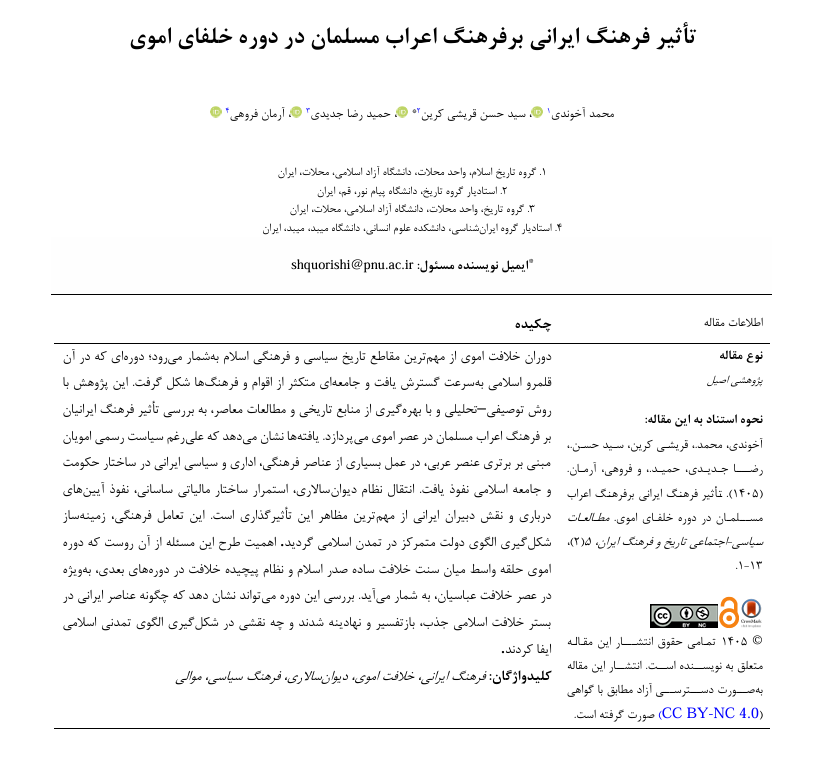
The Influence of Iranian Culture on the Culture of Muslim Arabs During the Umayyad Caliphate
Keywords:
Iranian culture, Umayyad Caliphate, bureaucracy, political culture, mawālī (non-Arab Muslim converts)Abstract
The Umayyad Caliphate represents one of the most significant periods in the political and cultural history of Islam, a period during which the Islamic realm expanded rapidly and a diverse society composed of various ethnicities and cultures emerged. Using a descriptive–analytical approach and drawing upon historical sources and contemporary scholarship, this study examines the influence of Iranian culture on the culture of Muslim Arabs during the Umayyad era. The findings indicate that despite the official Umayyad policy of privileging the Arab element, numerous Iranian cultural, administrative, and political institutions penetrated the structure of the government and Islamic society in practice. The transfer of bureaucratic institutions, the continuation of the Sasanian taxation system, the adoption of courtly traditions, and the influential role of Iranian secretaries and administrators were among the most prominent manifestations of this cultural influence. This cultural interaction contributed to the formation of a centralized model of governance within Islamic civilization. The significance of this issue lies in the fact that the Umayyad period constituted a transitional stage between the relatively simple caliphal tradition of early Islam and the more complex caliphal system that emerged in subsequent periods, particularly during the Abbasid Caliphate. Examining this period demonstrates how Iranian elements were absorbed, reinterpreted, and institutionalized within the framework of the Islamic Caliphate and highlights their role in shaping the civilizational model of Islam.
Downloads
References
Ali, J. (1993). Al-Mufassal fi Tarikh al-Arab Qabl al-Islam. University of Baghdad.
Azarnoush, A. (1975). Ways of Persian Influence in Arabic Culture and Language Before Islam (1 ed.). University of Tehran.
Azarnoush, A. (1998). History of the Arabic Language and Culture (1 ed.). SAMT Publications.
Baladhuri, A. (1958). Futuh al-Buldan. Noghreh Publishing.
Choksy, J. G. (2002). Conflict and Cooperation: Zoroastrian Subalterns and Muslim Elites in Medieval Iranian Society. Qoqnoos.
Dorri, N. (1989). The Influence of Iranians on Arabs in the Customs of Governance. Iranian Studies Journal(11).
Eftekhari Zadeh, M. R. (1997). Shuubiyyah and Iranian Nationalism (1 ed.). Office for Islamic Knowledge Publications.
Harirchi, F. (1966). Persian Arabic-Writing Authors: Abd al-Hamid al-Katib and Badi al-Zaman al-Hamadhani. Arzhang Printing House.
Hitti, P. (1965). History of the Arabs. Franklin.
Ibn al-Athir, I. (1991). The Complete History. Asatir.
Ibn Khaldun, A. (1984). Al-Ibar. Institute for Cultural Studies and Research.
Ibn Taqtaqi, M. i. A. i. T. (1988). Al-Fakhri History (3 ed.). Scientific and Cultural Publications.
Isfahani, H. i. H. (1961). Sani al-Muluk wa al-Ard wa al-Anbiya. Kaviani Press.
Maqdisi, A. S. (1987). Ahsan al-Taqasim fi Marifat al-Aqalim. Ihya al-Turath al-Arabi.
Masudi, A. i. H. (1995). Muruj al-Dhahab. Scientific and Cultural Publishing Company.
Mohammadi Malayeri, M. (2000). History and Culture of Iran During the Transition from the Sasanian Era to the Islamic Era. Tus.
Mostowfi Qazvini, H. i. A. B. (1984). Tarikh-i Guzida. Amir Kabir.
Qalqashandi, A. i. A. (1987). Subh al-Asha fi Sinaat al-Insha (1 ed.). Dar al-Kutub al-Ilmiyyah.
Sami, A. (1986). The Role of Iranians in Islamic Culture and Civilization. Navid Publishing.
Shariati, A. (1999). History of Civilization. Qalam.
Spuler, B. (1994). History of Iran in the Early Islamic Centuries. Scientific and Cultural Publications.
Tabari, M. i. J. (1996). History of al-Tabari. Asatir.
Taqizadeh, H. (1950). History of Arabia and the Arab People at the Dawn of Islam and Before It. Faculty of Theology and Islamic Studies Publications.
Yaqubi, A. i. I. (1992). History of Yaqubi. Scientific and Cultural Publications.
Yarshater, E. (2002). The Presence of Iran in the Islamic World. Morvarid.
Zarrinkoub, A. H. (1983). History of Iran After Islam. Amir Kabir.
Zaydan, J. (1994). History of Islamic Civilization. Amir Kabir.
Downloads
Publication Timeline
- Submitted
- Revised
- Accepted
Issue
Section
License
Copyright (c) 2025 Mohammad Akhoundi (Author); Seyed Hassan Ghoreishi Karain (Corresponding Author); Hamid Reza Jadidi, Arman Forouhi (Author)

This work is licensed under a Creative Commons Attribution-NonCommercial 4.0 International License.