The Impact of Iranian Liberalism on the Formation of Political Discourses in the Islamic Republic of Iran
Keywords:
Liberalism, Secularism, Political Discourses, IranAbstract
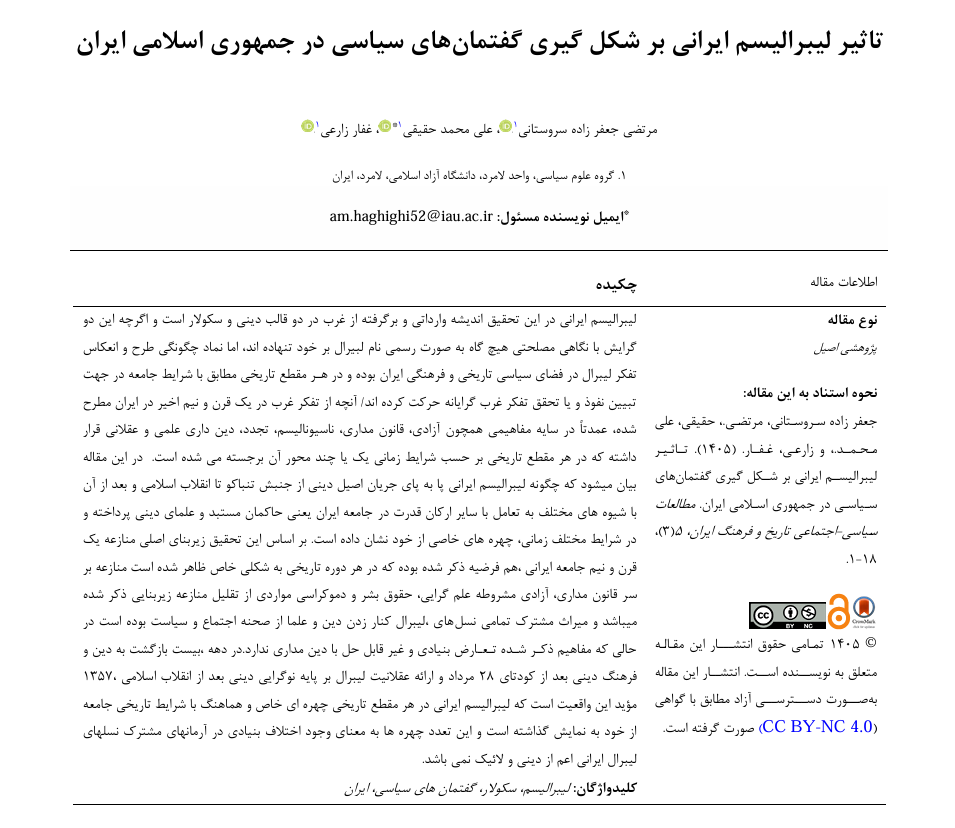
In this study, Iranian liberalism is understood as an imported body of thought derived from the West and manifested in two religious and secular forms. Although, for pragmatic reasons, neither tendency has ever formally described itself as liberal, both have represented the manner in which liberal thought has been articulated and reflected within Iran’s political, historical, and cultural context. At each historical juncture, these tendencies have operated in accordance with prevailing social conditions to explain, advance, or realize Western-oriented thought. Over the past century and a half, Western thought in Iran has largely been introduced through concepts such as freedom, the rule of law, nationalism, modernization, and scientific and rational religiosity, with one or more of these themes becoming prominent depending on the historical circumstances of each period.
This article explains how Iranian liberalism, alongside the authentic religious movement, interacted in various ways with the other principal centers of power in Iranian society—namely, authoritarian rulers and religious scholars—from the Tobacco Protest to the Islamic Revolution and its aftermath. Under different historical conditions, Iranian liberalism assumed distinct forms and presented different public manifestations.
According to the findings of this study, the principal foundation of political and intellectual conflict in Iranian society over the past century and a half has been the aforementioned proposition, which has appeared in a particular form during each historical period. Disputes over the rule of law, constitutional freedom, scientism, human rights, and democracy represent specific manifestations or reductions of this underlying conflict. The common legacy of successive generations of Iranian liberals has been the attempt to marginalize religion and religious scholars from the social and political spheres, even though the aforementioned concepts are not inherently or irreconcilably incompatible with religious commitment.
The revival of religion and religious culture during the 1940s, the developments following the coup of August 19, 1953, and the formulation of liberal rationality on the basis of religious modernism after the 1979 Islamic Revolution confirm that Iranian liberalism has assumed a distinctive form compatible with the historical conditions of Iranian society in each period. This plurality of manifestations, however, does not indicate any fundamental divergence among the shared ideals of successive generations of Iranian liberals, whether religious or secular.
Downloads
References
Akbar, A. (1991). A Survey of Contemporary Political Thought. Alast Publications.
Akhundzadeh, M. F.-A. (1963). The New Alphabet and Letters. Publishing Center of the Academy of Sciences of the Soviet Socialist Republic.
Amiri, J. (2018). Iranian Liberalism. Islamic Culture and Thought Research Institute.
Bahar, M. T. (1978). A Brief History of Political Parties in Iran. Pocket Books Publications.
Bashiriyeh, H. (1999). Civil Society and Political Development in Iran. Ney Publishing.
Bashiriyeh, H. (2002). History of Political Thought in the Twentieth Century. Ney Publishing.
Bastani Parizi, E. (1975). The Effort for Freedom: The Political Environment and Life of Moshir al-Dowleh Pirnia. Nashr-e Novin.
Bazargan, A. (1983). Problems and Issues of the First Year of the Revolution in the Words of Engineer Bazargan (2nd ed.). Bahar.
Cheney, R. D. (1993). American Defense Strategy in a Changing World (M. H. Jamshidi, Trans.). In Collection of Articles of the Command and Staff College of the Islamic Revolutionary Guard Corps. Office of Studies.
Fayyaz, E. (2013). Political Discourses in the Islamic Republic of Iran. Soroush.
Hosseinizadeh, S. A. (2011). Freedom in the Political Discourses of the Islamic Republic of Iran [Master's thesis, Baqir al-Ulum University].
Lakzaei, N. (2002). Contemporary Islamic Political Thought. Bustan-e Ketab.
Sariolghalam, M. (2007). Rationality and Development in Iran. Strategic Studies Research Institute.
Sarparast Sadat, S. E. (2015). Typology and Critical Re-Identification of Democracy among the Iranian Current Inclined toward Liberalism in the Islamic Republic Period. Political Science Research Journal, 10(4), 75-110.
Tajik, M. (2004). Discourse Analysis and Politics. Farhang-e Gofteman.
Tezcur, G. M., Azadarmaki, T., Bahar, M., & Nayebi, H. (2012). Support for Democracy in Iran. Political Research Quarterly, 65(2), 235-247. https://doi.org/10.1177/1065912910395326
Vaezi, A. (2003). Islam and Liberalism. Political Science Quarterly, 6(22), 117-144.
Downloads
Publication Timeline
- Submitted
- Revised
- Accepted
Issue
Section
License
Copyright (c) 2025 Morteza Jafarzadeh sarvestani (Author); Ali Mohammad Haghighi; Ghaffar Zarei (Author)

This work is licensed under a Creative Commons Attribution-NonCommercial 4.0 International License.