An Anthropological Analysis of Family and Fertility Systems from the Perspective of Tehran Citizens: A Comparative Study of Tehran Municipality Districts 3 and 19
Keywords:
Family and kinship, fertility, childbearing, anthropology of kinship, marriageAbstract
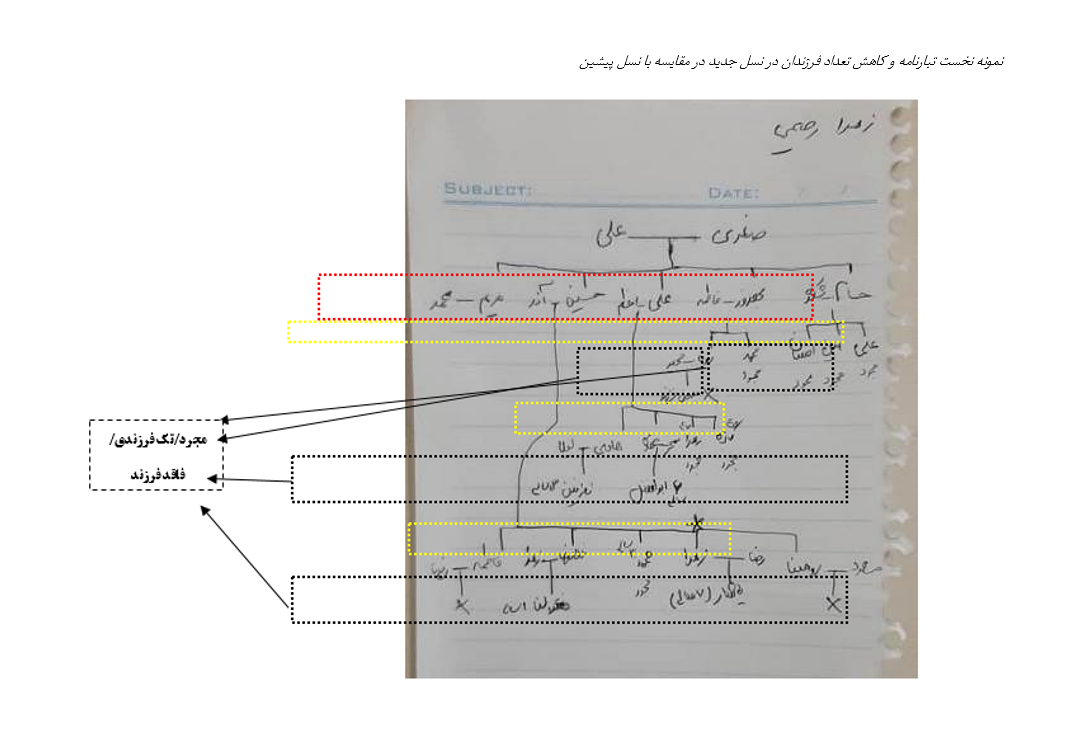
The present study aimed to provide an anthropological analysis of transformations in the family system and the factors shaping fertility attitudes and behaviors among citizens of Davoodieh in Tehran Municipality District 3 and Khaniabad-e Now in District 19. A qualitative comparative ethnographic design was employed. The participants consisted of 30 married residents selected through purposive and snowball sampling, with 15 in-depth interviews conducted in each neighborhood. Data were collected through in-depth and semi-structured interviews, informal conversations, field observations, field notes, and the construction of family genealogies. The materials were analyzed using thematic analysis and continuous comparison between the two research settings. The findings indicated that families in both neighborhoods had moved from extended, kinship-oriented, and relatively large arrangements toward nuclear, couple-centered, planned, and low-fertility structures. Children were no longer primarily regarded as economic contributors, sources of parental support in old age, or instruments for preserving marital stability. Instead, they were understood as the focus of long-term emotional, educational, developmental, and financial investment. Economic insecurity, rising housing, education, and childcare costs, women’s employment and higher education, unequal distribution of domestic responsibilities, uncertainty about the future, social-media influence, concerns about health and bodily changes, and increasingly demanding standards of parenthood were the major factors limiting childbearing. Despite the socioeconomic differences between the two neighborhoods, the one-child or two-child family model predominated in both settings. In Khaniabad-e Now, concerns centered more strongly on meeting basic needs, whereas in Davoodieh, maintaining educational quality, welfare standards, and social status was more prominent. The genealogies also confirmed an intergenerational decline in family size and an increase in delayed marriage, childlessness, and one-child families. Overall, low fertility may be interpreted as an adaptive family strategy for managing contemporary economic, social, and cultural conditions, although its widespread adoption may generate significant long-term demographic consequences.
Downloads
References
Abbasi, M., & Khani, S. (2013). Economic Insecurity and Fertility: A Case Study of Married Women in Sanandaj County. Journal of the Demographic Society of Iran, 33-71.
Afshar Kohan, J., & Rezaeian, M. (2018). An Intergenerational Comparison of the Relationship between Individual Value Systems and Attitudes toward Family Stability. Sociology of Social Institutions, 5(12), 293-326.
Alizadeh, S., Mirmiran, P., & Hajifoghaha, M. (2017). The Role of Nutrition in Female and Male Fertility. Journal of Babol University of Medical Sciences, 19(4), 7-91.
Azad Armaki, T. (2016). Changes, Challenges, and the Future of the Iranian Family. Tisa Publishing.
Azad Armaki, T., & Zahiriniya, M. (2019). An Examination of Value Types and Cultural Changes in the Family. Family Research Quarterly(23).
Bani Hashemi, H., Sarvar, R., & Ziari, Y. A. (2013). Infill Development in Deteriorated Urban Fabrics: The Case of Khaniabad Neighborhood in Tehran. Sarzamin Geographical Quarterly, 10(40).
Barcellos, C. (2011). The Experience of Pregnancy: Subjectivity and Social Relations. Vibrant: Virtual Brazilian Anthropology, 8(2). https://doi.org/10.1590/S1809-43412011000200026
Brown, N., & McIlwraith, T. (2020). Perspectives: An Open Introduction to Cultural Anthropology. American Anthropological Association.
Chamani, S., Moshfegh, M., & Shakarbeygi, A. (2016). A Mixed-Methods Study of Childbearing Challenges in Tehran. Gender and Family Studies, 3(1).
Cheraghi, M. (2018). A Psychological Analysis of Parent–Child Relationships in Iranian Proverbs. Family Research, 383-410.
Eller, J. D. (2015). Cultural Anthropology. Routledge.
Essén, B., Binder, P., & Johnsdotter, S. (2011). An Anthropological Analysis of the Perspectives of Somali Women in the West and Their Obstetric Care Providers on Caesarean Birth. Journal of Psychosomatic Obstetrics & Gynecology, 32(1), 10-18.
Fakouhi, N. (2012). Foundations of Anthropology. Ney Publishing.
Farbod, M. S. (2016). An Introduction to Family and Kinship: Anthropology of Family and Kinship. Danjeh Publishing.
Farbod, M. S. (2018). Foundations of Anthropology. Golazin Publishing.
Foroutan, Y., & Karami, F. (2016). Patterns and Determinants of Childbearing Intentions in Iran. Journal of the Demographic Society(21), 71-100.
Ghaderi, T., & Alghouneh, Z. (2017). An Examination of Egoistic Individualism and Its Related Factors among Students at Shiraz University, with Emphasis on Social Class. Social Sciences Quarterly, 26(79).
Ghasemi, A., Rad, F., & Savabi, H. (2014). An Examination of Changes in Women's Fertility according to the Socioeconomic Positions of Couples. Quarterly Journal of the Women's and Family Social-Cultural Council, 16(63).
Hashemi, A. (2012). Changes in Cultural Patterns and Elements from the Extended Family to the Nuclear Family. Iranian Culture and People Quarterly(31), 11-27.
Jafari Bai, M. (2019). An Examination of the Transformation of the Iranian Family through Demographic Indicators. Population Quarterly(109-110), 121-153.
Kaveh Firouz, Z. (2017). The Effect of Social and Cultural Capital Components on Attitudes toward Childbearing. Social Studies and Research in Iran(1), 119-143.
Khorramshahi, B. (2018). The Bustan of Saadi. Doustan Publishing.
Lenkeit, R. E. (2011). Cultural Anthropology. McGraw-Hill Education.
Masoumi, M., & Rahiminejad, V. (2012). Women and Gendered Proverbs. Quarterly Journal of Persian Language and Literature(11), 135-158.
Mehrabani, V. (2013). A Comparative Examination of Fertility-Economics Models and Schools Using Iranian Data. Journal of the Demographic Society of Iran(16), 5-27.
Modiri, F., & Ghazi Tabatabaei, M. (2018). The Effect of Marital Quality of Life on Fertility Intentions. Sociology of Social Institutions(12), 73-94.
Moltafat, H., Navah, A., & Rashidi, S. (2020). An Analysis of the Relationship between Lifestyle and Fertility Decline. Sociology and lifestyle management(16), 401-438.
Panahi, H. (2012). Family Health and Its Social Determinants. Social Sciences Quarterly(59).
Rasoulzadeh Aghdam, S., Adlipour, S., & Mirmohammadtabar, A. (2016). An Analysis of the Relationship of Social Capital and Lifestyle with the Tendency toward Childbearing: A Study of Students at Shahid Madani University of Azerbaijan. Social and Cultural Strategy Quarterly, 5(20).
Rastegar Khaled, A., & Mohammadi, M. (2015). Cultural Change and Fertility Decline in Iran. Journal of Applied Sociology, 26(58).
Razeghi Nasrabad, H., & Modiri, F. (2015). The Relationship between Religiosity and Fertility Intentions in Tehran. Journal of the Demographic Society, 127-162.
Sadeghi, H., & Saraei, H. (2016). Factors Affecting the Tendency toward Childbearing among Women in Tehran. Quarterly Journal of Welfare and Social Development Planning, 7(27).
Saeidi Madani, M., & Foroutan, Y. (2011). Patterns and Determinants of Sex Preference in Neka County, Mazandaran Province. Journal of the Demographic Society, 163-189.
Sayarpour, F. (2014). Anthropology of the Body. Journal of the Scientific Association of Anthropology.
Shabani, B. (2020). An Analytical Study of Didactic Teachings in Proverbs of the Jahromi Dialect. Quarterly Journal of Literature and Local Languages of Iran(30), 37-62.
Shabanpour, M., Vosoughi, M., & Kaldi, A. (2018). Explaining the Role of Kinship Networks in the Stability of the Nuclear Family: A Case Study of Tehran. Journal of Police-Social Research on Women and Family, 6(1), 13-124.
Soleimanifar, N. (2015). An Analysis of the Teachings of the Qur'an and the Torah concerning Childbearing and Population Growth. Tadabbur.
Zare, B., & Safiari, H. (2015). A Study of the Factors Associated with Marital-Life Satisfaction among Married Women and Men in Tehran. Quarterly Journal of Social and Psychological Studies of Women, 13(1).
Zare, S., & Hashemi, S. H. (2013). The Effect of Religion on Population and Fertility Policies. Islam and Social Sciences(10), 81-98.
Ziaei Bigdeli, M., Kalantari, S., & Alizadeh, M. (2018). The Relationship between the Total Fertility Rate and Socioeconomic Development. Social Welfare(21), 123-140.
Downloads
Publication Timeline
- Submitted
- Revised
- Accepted
Issue
Section
License
Copyright (c) 2025 Monireh Nourirraj (Author); Mohamadsadegh Farbod; Fariba Mireskandari (Author)

This work is licensed under a Creative Commons Attribution-NonCommercial 4.0 International License.