An Analysis of Power Relations and Popular Culture in the Safavid Era: A Case Study of Nowruz Carnivals
Keywords:
Safavid Era, Nowruz, Popular Culture, Power Relations, Carnival, Urban Rituals, Safavid ShiismAbstract
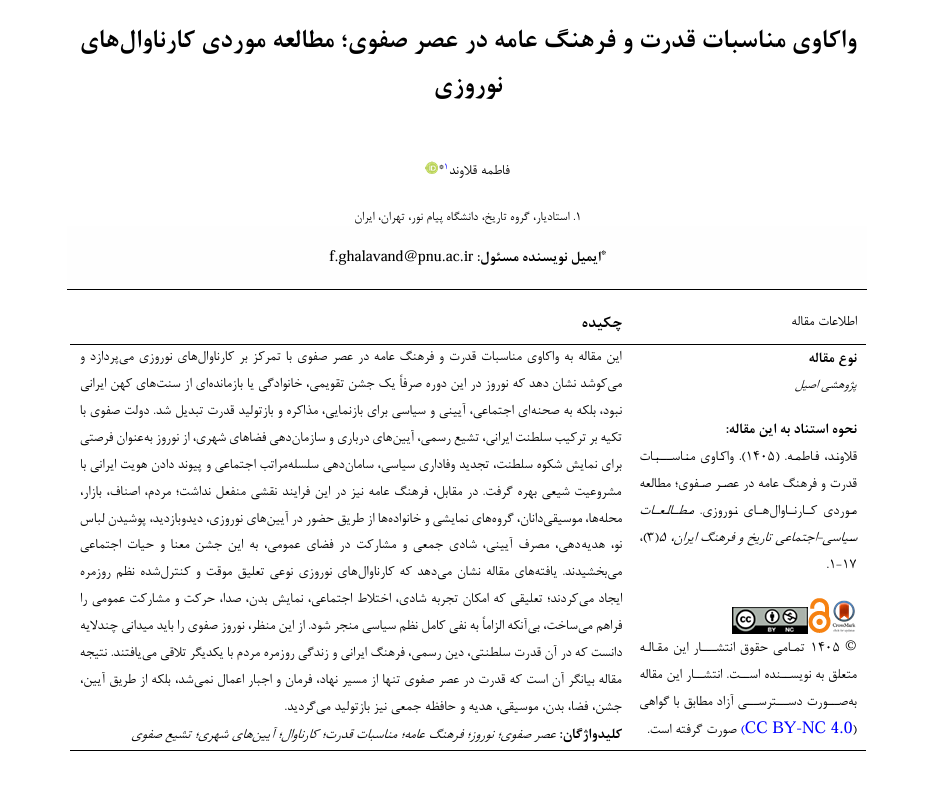
This article examines the relationship between power and popular culture in the Safavid era through a case study of Nowruz carnivals. It argues that Nowruz in this period was not merely a calendrical, domestic, or inherited Iranian festival, but a social, ritual, and political arena in which authority was represented, negotiated, softened, and reproduced. The Safavid state, relying on the combination of Iranian kingship, official Shiism, courtly ceremony, and the organization of urban space, used Nowruz as an opportunity to display royal magnificence, renew political loyalty, regulate social hierarchy, and connect Iranian cultural memory with Shiite legitimacy. At the same time, popular culture did not play a passive role in this process. Ordinary people, guilds, markets, neighborhoods, musicians, performers, and families gave social vitality to the festival through public participation, visits, new clothing, gift exchange, ritual consumption, collective joy, and festive presence in urban spaces. The findings show that Nowruz carnivals created a temporary and controlled suspension of everyday order. This suspension allowed for the experience of joy, social interaction, bodily display, sound, movement, and public participation, without necessarily leading to the complete rejection of political order. From this perspective, Safavid Nowruz should be understood as a multilayered field in which royal power, official religion, Iranian tradition, and everyday social life intersected. The article concludes that power in the Safavid period was not exercised only through institutions, commands, military force, or coercion. It was also reproduced through ritual, celebration, urban space, embodied performance, music, gift exchange, and collective memory. Therefore, the study of Nowruz carnivals provides a valuable perspective for understanding how early modern Iranian political authority operated through both official ceremony and the participatory energies of popular culture.
Downloads
References
Afushta'i Natanzi, M. i. H. A. (1994). The Selection of Reports on the Virtuous. Scientific and Cultural Publications.
Aghajari, H. (2001). The Interaction of Religion and State in Safavid Iran. Center for the Reexamination of Islam and Iran.
Babaie, S., Babayan, K., Baghdiantz-McCabe, I., & Farhad, M. (2004). Slaves of the Shah: New Elites of Safavid Iran. I.B. Tauris.
Chardin, J. (1988). Travels in Persia, 1673-1677. Dover Publications.
Della Valle, P. (1892). The Travels of Pietro Della Valle in India. Hakluyt Society.
Falsafi, N. (1968). The Life of Shah Abbas I. University of Tehran Press.
Jafarian, R. (2000). Religion and Politics in the Safavid Period. Ansariyan Publications.
Kaempfer, E., Floor, W., & Javadi, H. (1987). Kaempfer's Persia: Extracts from the Amoenitates Exoticae. Franz Steiner Verlag.
Matthee, R. (2005). The Pursuit of Pleasure: Drugs and Stimulants in Iranian History, 1500-1900. Princeton University Press.
Mirahmadi, M. (2023). Religion and State in the Safavid Era. Gostareh Press.
Miri, V., & Pirmoradian, M. (2019). A Historical Analysis of the Synchronization of the Nowruz and Ghadir Festivals in the Safavid Era. The Discourse of History, 13(30), 49-69.
Olearius, A. (1669). The Voyages and Travels of the Ambassadors Sent by Frederick Duke of Holstein to the Great Duke of Muscovy, and the King of Persia. John Starkey and Thomas Basset.
Parsaeirad, A., Soltan-Ahmadi, B., & Parsaeirad, A. (2020). Explaining Musical Life in the Safavid Era Based on Texts and European Travelers' Travelogues. Art and Civilization of the Orient.
Qumi, Q. A. i. S. a.-D. H. (1980). Summary of Histories. University of Tehran Press.
Ranjbar, M. A., & Mousavi, M. S. (2019). Iranian Customs and Traditions in the Safavid Era from Jean Chardin's Perspective. The Discourse of History, 13(30).
Ravandi, M. (1961). The Social History of Iran. Amir Kabir Publishing House.
Rumlu, H. B. (2005). The Best of Histories. Asatir Publications.
Savory, R. M. (1980). Iran under the Safavids. Cambridge University Press.
Sepehri, S. (2017). The Nowruz Ritual in the Safavid Period. Center for the Great Islamic Encyclopaedia. https://www.cgie.org.ir/fa/news/156039/
Shahbazi, A. S. (2000). NOWRUZ ii. In the Islamic Period. Encyclopaedia Iranica. https://www.iranicaonline.org/articles/nowruz-ii/
Tavernier, J.-B. (1889). Travels in India. Macmillan.
Turkmen, I. B. M. (1971). The World-Adorning History of Abbas. Amir Kabir Publishing House.
Turkmen, I. B. M. (1978). History of Shah Abbas the Great: The World-Adorning History of Abbas. Westview Press.
Zarneshan, Z., & Jafari, M. (2012). Nowruziyeh and Nowruziyeh Writing in the Safavid Era. Historical Researches, 3(2), 65-88.
Downloads
Publication Timeline
- Submitted
- Revised
- Accepted
Issue
Section
License
Copyright (c) 2025 Fatemeh Ghalavand (Corresponding Author)

This work is licensed under a Creative Commons Attribution-NonCommercial 4.0 International License.