Investigating the Impact of Social and Cultural Factors on Iranian Family Security: A Case Study of Tehran
Keywords:
Family security, feeling of social security, social factors, social capital, social trustAbstract
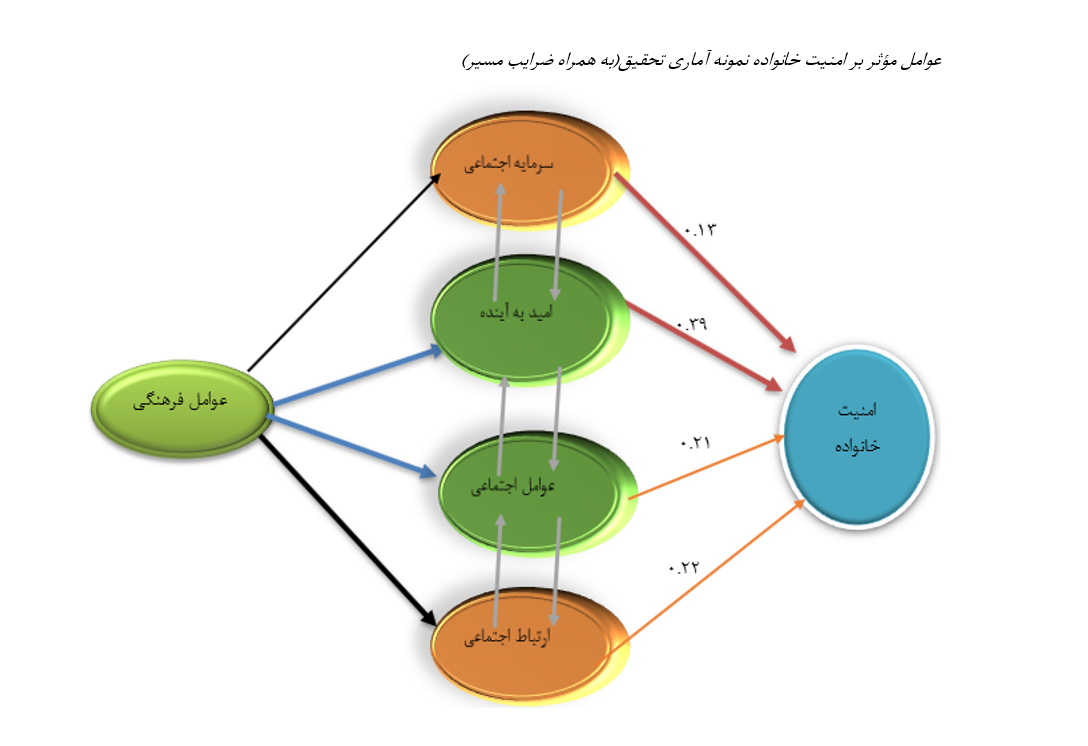
This study aimed to sociologically explain the direct and indirect effects of social and cultural factors on Iranian family security in Tehran. A mixed-methods qualitative–quantitative design was employed. In the quantitative phase, 402 Tehran residents aged 18 years and older were selected through multistage stratified-cluster sampling, and data were collected using an 88-item Likert-scale questionnaire. In the qualitative phase, 20 in-depth semi-structured interviews were conducted with experts and scholars in family and social studies until theoretical saturation was achieved. Face and construct validity were assessed, and internal consistency was examined using Cronbach’s alpha. Quantitative data were analyzed using independent-samples t-tests, one-way ANOVA, Pearson correlation, stepwise multiple regression, and path analysis, whereas qualitative data were analyzed through thematic content analysis. Family security was positively and significantly associated with social factors (r=.57), hope for the future (r=.60), social capital (r=.44), cultural factors (r=.42), and social connections (r=.41; p<.001). The multiple regression model was significant (R=.704, adjusted R²=.490, F=97.493, p<.001), explaining 49% of the variance in family security. Hope for the future (β=.385), social connections (β=.215), social factors (β=.208), and social capital (β≈.13) were significant direct predictors. Path analysis indicated total effects of .53 for hope for the future, .44 for social factors, .33 for social connections, and .27 for social capital. Cultural factors primarily exerted an indirect effect, with a total effect of .23. Significant differences in several dimensions of family security were also observed across gender, age, occupational, educational, and income groups. Family security in Tehran is shaped by the combined operation of social resources and cultural conditions. Hope for the future, social connections, and social capital constitute the principal direct mechanisms, while cultural factors operate mainly through these social pathways. Accordingly, policies aimed at strengthening family security should simultaneously promote social optimism, social capital, interpersonal connections, and cultural cohesion.
Downloads
References
Afshani, S. A., Fazel Najafabadi, S., Heydari, M., & Nourian Najafabadi, M. (2010). A Study of the Relationship between Religiosity and Social Trust. Quarterly Journal of Social sciences(49), 185-217.
Alikhah, F., & Najibi Rabiei, M. (2007). Women and Fear of Crime in Urban Spaces. Social Welfare, 6(22), 109-131.
Buzan, B. (1999). People, States and Fear (1st ed.). Institute for Strategic Studies.
Fallahi, A. (2000). The Mechanism of Creating Trust-Security Regimes. Rahbord Quarterly(18).
Foster, S., Knuiman, M., Villanueva, K., Wood, L., Christian, H., & Giles-Corti, B. (2014). Does Walkable Neighbourhood Design Influence the Association between Objective Crime and Walking? International Journal of Behavioral Nutrition and Physical Activity, 11, 100.
Jacobs, J. (1961). The Death and Life of Great American Cities. Random House.
Kazemi, S. M., Mousa Rafieian, M., & Ghasemi Shah-Goldi, A. (2014). Factors Affecting the Improvement of Security in Urban Neighborhoods: A Case Study of North Jannat-Abad, Tehran. Geographical Space, 14(45), 129-147.
Moayyedi, M., Alinejad, M., & Navaei, H. (2013). Examining the Role of Urban Landscape Components in Enhancing the Sense of Security in Urban Public Spaces: A Case Study of Evin Neighborhood, Tehran. Social Security Studies(35), 159-191.
Modiri, A. (2006). Crime, Violence, and the Feeling of Security in Urban Public Spaces. Social Welfare, 6(22).
Newman, O. (1973). Defensible Space: People and Design in the Violent City.
Paul, E., Rachel, A., Leanne, M., & Ben, C. (2013). Crime Prevention through Environmental Design in the United Arab Emirates: A Suitable Case for Reorientation? Built Environment, 39(1), 92-113.
Saroukhani, B. (1996). An Introduction to the Sociology of the Family. Soroush.
Saroukhani, B., & Navidnia, M. (2006). Social Security of the Family and Place of Residence in Tehran. Social Welfare, 6(22).
Schneider, R. H., & Kitchen, T. (2013). Putting Crime Prevention Through Environmental Design into Practice via Planning Systems: A Comparison of Experience in the US and UK. Built Environment, 39(1), 9-30.
Tajik, M. R. (2001). An Introduction to the National Security Strategy of the Islamic Republic: Approaches and Strategies, Volume 1 (1st ed.). Farhang-e Gofteman.
Downloads
Publication Timeline
- Submitted
- Revised
- Accepted
Issue
Section
License
Copyright (c) 2025 Amir Jafari (Author); Hoshang Zahiri; Habibollah Karimian (Author)

This work is licensed under a Creative Commons Attribution-NonCommercial 4.0 International License.